Thermoplastics Enter the Structural Core Market
For a long time, honeycomb cores were dominated by paper, aluminum, and thermoset-based composites. Each of these materials served specific markets, but all of them carried limitations when exposed to moisture, repeated impact, recycling requirements, or complex forming needs.
Thermoplastic honeycomb cores have entered this space with a different value logic. Instead of relying on chemical curing and irreversible crosslinking, they use heat-formable polymers such as PP, PET, PC, and modified blends. This change is not only about material choice; it reshapes how structural efficiency is defined, produced, and applied.
In transportation, mobile structures, industrial enclosures, and modular systems, thermoplastic honeycomb cores are no longer seen as experimental. They are being specified in projects where weight, fatigue life, moisture resistance, and recyclability are all treated as engineering requirements rather than optional features.

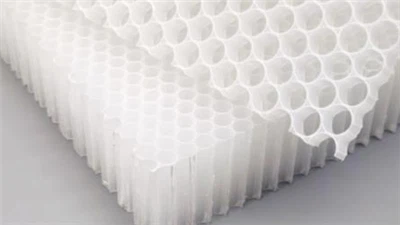
Open Cell PP Honeycomb Core

PP Honeycomb with Non-Woven Fabric
What "Structural Efficiency" Means in Engineering Terms
Structural efficiency is not simply about strength. It is about how much performance is obtained per unit of material, per unit of weight, and per unit of cost.
In technical terms, it is commonly evaluated through:
Strength-to-weight ratio
Stiffness-to-weight ratio
Energy absorption per mass
Fatigue resistance under cyclic load
Stability under temperature and humidity changes
A core material with high structural efficiency provides mechanical contribution far beyond what its mass alone would suggest. Honeycomb geometry already offers this advantage by separating load paths into thin walls arranged in a cellular structure. Thermoplastics enhance this further by introducing controlled ductility, impact tolerance, and manufacturing flexibility.
Geometry as the Primary Load-Bearing Mechanism
The efficiency of honeycomb cores begins with geometry. Hexagonal, rectangular, and modified cell structures distribute forces through multiple thin walls rather than through solid volume.
In bending:
Face sheets carry tension and compression
The core resists shear and maintains separation between faces
Greater separation means higher bending stiffness
Thermoplastic honeycomb cores allow precise control over:
Cell size
Wall thickness
Core height
Orientation and density gradients
This means engineers can tune the structure to match specific load cases. Instead of using "more material," they use "better geometry."
In mobile and modular structures, where loads vary across different zones, this tunability becomes critical. Floors, walls, roofs, and partitions do not require the same performance, and thermoplastic cores allow graded structural design without changing the entire system.
Material Behavior Under Load
Unlike brittle core materials, thermoplastics exhibit controlled ductility. When stressed:
They deform before breaking
They absorb energy through plastic deformation
They resist crack propagation
This behavior is particularly valuable under:
Impact loads
Vibration
Repeated cyclic stress
In structural panels, core failure often begins as localized crushing or shear collapse. Thermoplastic honeycomb cores tend to show progressive deformation rather than sudden collapse. This gives designers more predictable performance and safer failure modes.
From a structural efficiency standpoint, this means more usable energy absorption per unit mass, especially in applications where impact or vibration is unavoidable.
Shear Performance and Core Stability
The core's main structural role is to resist shear between the face sheets. If the core fails in shear, the entire sandwich structure loses its bending stiffness.
Thermoplastic honeycomb cores offer:
Stable shear modulus across a wide temperature range
Resistance to moisture-induced softening
Consistent behavior under long-term loading
In contrast, some traditional cores lose shear strength in humid conditions or become brittle in cold environments.
By maintaining shear performance in real-world conditions, thermoplastic cores ensure that structural efficiency measured in the lab remains valid in actual service.
Weight Optimization and Density Control
One of the major advantages of thermoplastic honeycomb is density control. Through extrusion and thermoforming processes, manufacturers can precisely adjust:
Wall thickness
Cell geometry
Overall core density
This allows structural designers to match weight directly to performance needs.
Instead of choosing between "light" and "heavy" cores, they can specify:
Ultra-light cores for interior partitions
Medium-density cores for walls and roofs
High-density cores for floors and load-bearing platforms
Structural efficiency improves when no area of a structure is over-designed. Thermoplastic honeycomb enables this fine-tuning at industrial scale.
Fatigue Resistance in Dynamic Environments
Many modern structures operate under constant motion: vehicles, mobile buildings, marine equipment, rail systems, and industrial platforms.
Fatigue damage accumulates through:
Vibration
Small repeated impacts
Thermal expansion and contraction
Cyclic loading from use
Thermoplastic honeycomb cores show strong fatigue resistance because:
Their ductility reduces micro-crack formation
Stress is distributed across many thin walls
Local damage does not easily propagate
This allows sandwich panels to maintain stiffness and geometry over long service periods, even when exposed to millions of load cycles.
Structural efficiency is not only about initial performance but also about how well that performance is retained over time.
Moisture and Environmental Stability
Structural materials rarely operate in perfect laboratory conditions. They face:
Humidity
Water exposure
Temperature fluctuations
Chemicals and pollutants
Thermoplastic cores are naturally resistant to moisture absorption. Unlike paper or some resin-based cores, they do not swell, rot, or lose mechanical integrity when exposed to water.
This stability ensures:
Consistent shear strength
Stable panel thickness
Reliable bonding with face sheets
Structural efficiency depends on predictability. A material that performs well only under controlled conditions cannot be considered truly efficient in real engineering terms.
Manufacturing Efficiency as Part of Structural Efficiency
Structural efficiency is often discussed purely in mechanical terms, but manufacturing efficiency also matters. A structure that is difficult to produce or inconsistent in quality loses efficiency at the system level.
Thermoplastic honeycomb cores offer:
Continuous extrusion and forming processes
Stable dimensional control
Compatibility with automated lamination lines
Consistent quality from batch to batch
They can be thermoformed into curved or shaped cores, enabling complex panel designs without cutting and reassembling multiple pieces.
This manufacturing flexibility allows structural concepts to move from design to production without excessive compromise, which preserves the intended efficiency of the structure.
Bonding and Interface Performance
In sandwich structures, the interface between core and face sheets is critical. Structural efficiency collapses if bonding fails.
Thermoplastic honeycomb cores are compatible with:
Thermoplastic skins through heat bonding
Thermoset skins through adhesive systems
Hybrid structures using mechanical fastening
Their surface chemistry and controlled geometry allow strong, consistent bonding. This ensures that loads are transferred efficiently between faces and core, allowing the full sandwich structure to perform as designed.
Weak interfaces turn even the best core geometry into wasted potential.
Energy Absorption and Safety-Oriented Design
In transportation and mobile structures, energy absorption is as important as stiffness. Panels must not only carry loads but also manage impact energy.
Thermoplastic honeycomb cores absorb energy through:
Progressive wall buckling
Controlled plastic deformation
Layer-by-layer collapse under impact
This makes them suitable for:
Vehicle body panels
Protective enclosures
Crash-relevant structural zones
High energy absorption per unit mass is a strong indicator of structural efficiency in safety-oriented applications.
Recyclability and Circular Design Logic
Modern structural engineering increasingly includes environmental metrics.
Thermoplastic honeycomb cores support:
Material recycling
Reprocessing into new products
Integration into circular material systems
Unlike thermoset cores, they do not require chemical breakdown to be reused. This does not change their mechanical performance directly, but it changes how their efficiency is evaluated at a system level.
A structure that delivers performance while supporting reuse and recycling is increasingly considered more "efficient" in long-term industrial logic.
Typical Applications Driving Adoption
Thermoplastic honeycomb cores are now widely used in:
Vehicle floors and walls
Truck and trailer bodies
Rail interiors
Marine panels
Container-based buildings
Industrial enclosures
Modular housing systems
These applications share common priorities:
Low weight
High stiffness
Durability under motion
Environmental stability
Manufacturing scalability
Their adoption is not driven by fashion or novelty, but by performance data under real operating conditions.
Structural Design Language Is Shifting
As thermoplastic honeycomb cores become more common, the language of structural design changes.
Designers talk less about:
Thickness alone
Material hardness alone
And more about:
Stiffness per kilogram
Shear modulus of the core
Fatigue life under cyclic load
Energy absorption efficiency
Performance retention over time
Thermoplastic honeycomb fits naturally into this performance-driven language. It is not defined by being "plastic," but by what its structure can do.
From Material Choice to Structural Strategy
Using thermoplastic honeycomb is not just choosing a different core; it is adopting a different structural strategy.
Instead of building strength by adding mass, engineers build it through:
Geometry
Layer interaction
Load-path design
Tuned density distribution
Thermoplastic honeycomb cores provide the material platform that allows this strategy to be implemented at scale.
They turn structural efficiency from an abstract concept into a measurable, manufacturable, and repeatable engineering solution.