Structural Shift in Industrial Board Materials
Industrial manufacturing and construction rely on board materials to form load-bearing structures, enclosures, and functional surfaces. Traditional boards include solid wood panels, plywood, medium-density fiberboard, and homogeneous metal plates. These materials depend on bulk density and thickness to meet mechanical requirements, which increases structural mass and material consumption.
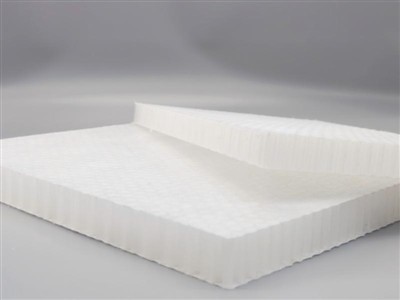
Lightweight honeycomb panels are sandwich-structured composites designed to address the limitations of traditional boards. They consist of a continuous hexagonal cellular core bonded between two rigid outer skins. Hangzhou Holycore develops and produces thermoplastic honeycomb panels under the HolyPan product line, using polypropylene for the core and fiberglass-reinforced thermoplastic for the skins. The panels undergo thermal compression to fuse core and skins without additional adhesives, creating a unified structure that transfers loads efficiently. This manufacturing process eliminates weak adhesive layers and ensures consistent performance across standard and custom panel dimensions.
Core Structural Differences Between Honeycomb Panels and Traditional Boards
Load Distribution Mechanism
Traditional boards use homogeneous material distribution to resist external forces. Solid wood or metal plates transfer loads through direct material contact, which creates stress concentration at bending points or impact zones. This concentration leads to localized deformation, cracking, or permanent warping under repeated loads.
Honeycomb panels distribute loads through a hexagonal cellular network. When force applies to the outer skins, the core's interconnected cells transfer stress across multiple load paths, reducing concentration at any single point. The hexagonal geometry maintains stability under compression and bending, allowing the panel to retain shape without localized failure. Hangzhou Holycore's HolyPan panels use uniform cell sizing to ensure even load distribution across the entire panel surface, supporting consistent performance in dynamic load environments.
Material Utilization Efficiency
Traditional boards require full material volume to achieve stiffness. Plywood uses layered wood veneers bonded with adhesive, while metal plates rely on solid metal thickness. Both methods consume excess material that does not contribute to structural performance, increasing weight and resource use.
Honeycomb panels minimize material use by replacing solid core material with hollow hexagonal cells. The outer skins provide stiffness, while the core maintains skin separation and transfers shear forces. This design reduces material volume while preserving mechanical performance. Hangzhou Holycore's thermoplastic core uses continuous extrusion to form uniform hexagonal cells, ensuring material efficiency without compromising structural integrity. The panels' material composition reduces raw material consumption compared to solid wood or metal boards of equivalent stiffness.
Dimensional Stability Under Environmental Changes
Traditional boards respond to temperature and humidity fluctuations with dimensional variation. Wood-based panels absorb moisture and expand, then shrink as humidity drops, causing warping or cracking. Metal plates expand and contract with temperature changes, creating stress at connection points.
Honeycomb panels resist dimensional variation through their composite structure. The thermoplastic core and fiberglass-reinforced skins have low thermal expansion coefficients, reducing movement under temperature changes. The sealed cellular structure prevents moisture penetration, eliminating swelling or shrinking from humidity. Hangzhou Holycore's HolyPan panels maintain flatness and structural stability in environments with varying temperature and humidity, avoiding the warping common to wood-based boards.
Mechanical Performance Advantages Over Traditional Boards
Strength-to-Weight Ratio
Traditional boards link strength directly to weight. Increasing load capacity requires proportional increases in thickness or density, which adds structural mass. Solid metal plates provide high strength but carry significant weight, while plywood reduces weight but sacrifices load capacity.
Honeycomb panels deliver high strength at reduced weight. The hexagonal core provides compressive strength, while the outer skins offer tensile strength. This combination creates a strength-to-weight ratio that exceeds traditional boards. Hangzhou Holycore's HolyPan panels support loads equivalent to thicker plywood or metal plates while weighing substantially less. The panels reduce structural mass in applications such as vehicle bodies and building envelopes, lowering energy consumption during operation.
Resistance to Deformation and Impact
Traditional boards deform under sustained or repeated loads. Plywood bends under heavy static loads and develops cracks from impact. Metal plates dent under impact and fatigue under cyclic loading.
Honeycomb panels resist deformation through their cellular core. The hexagonal cells absorb impact energy by distributing force across the core, preventing localized damage. The outer skins resist abrasion and puncture, maintaining surface integrity. Hangzhou Holycore's thermoplastic panels withstand repeated impact without cracking or denting, outperforming plywood and thin metal plates. The panels' impact resistance extends service life in material handling and industrial equipment applications.
Shear and Buckling Resistance
Traditional boards fail under shear stress or buckling. Plywood delaminates under shear forces, while thin metal plates buckle under compressive loads. Both failure modes limit structural span and load capacity.
Honeycomb panels resist shear and buckling through core-skin bonding. The core transfers shear forces between skins, preventing delamination. The cellular structure provides internal support, reducing buckling under compression. Hangzhou Holycore's thermal fusion process creates a strong bond between core and skins, eliminating delamination risks. The panels support longer spans without intermediate bracing, expanding design possibilities compared to traditional boards.
Durability and Environmental Resistance
Corrosion and Moisture Resistance
Traditional boards degrade in humid or corrosive environments. Wood-based panels absorb moisture and rot, while metal plates corrode when exposed to moisture or chemicals. These issues require frequent maintenance and replacement.
Honeycomb panels resist moisture and corrosion through non-porous materials. Thermoplastic cores and fiberglass-reinforced skins do not absorb moisture, preventing rot or swelling. The materials resist chemical exposure, maintaining structural integrity in industrial environments. Hangzhou Holycore's HolyPan panels withstand high humidity and chemical contact without degradation, eliminating the maintenance required for wood or metal boards.
UV and Weathering Resistance
Traditional boards degrade under outdoor exposure. Plywood fades and delaminates from UV radiation, while metal plates rust and pit. These changes reduce structural performance and appearance.
Honeycomb panels resist weathering through surface coatings and stable materials. The fiberglass-reinforced skins accept UV-resistant coatings that prevent degradation. The thermoplastic core maintains stability under temperature fluctuations. Hangzhou Holycore's panels retain surface quality and structural performance after prolonged outdoor exposure, outperforming plywood and uncoated metal plates in marine and construction applications.
Long-Term Wear and Tear
Traditional boards wear quickly under industrial use. Plywood surfaces scratch and splinter, while metal plates develop scratches and dents. Both require frequent repair or replacement.
Honeycomb panels resist wear through durable outer skins. The fiberglass-reinforced surface resists scratching and abrasion, maintaining smoothness under heavy use. The core structure prevents surface denting, preserving appearance and performance. Hangzhou Holycore's panels maintain surface integrity in high-traffic industrial environments, reducing replacement frequency compared to traditional boards.
Manufacturing and Installation Efficiency
Fabrication Flexibility
Traditional boards have limited fabrication options. Plywood cuts into flat panels but resists shaping into curves. Metal plates require specialized bending equipment, increasing processing time.
Honeycomb panels support versatile fabrication. They cut to standard or custom dimensions with standard tools. The thermoplastic core allows shaping into curves under controlled heat, enabling complex designs. Hangzhou Holycore's panels adapt to custom shapes for vehicle bodies, yacht components, and modular building parts. The fabrication process reduces waste compared to cutting solid wood or metal plates.
Installation Speed and Labor Reduction
Traditional boards require time-consuming installation. Plywood needs framing for support, while metal plates require heavy lifting and precise alignment. Both increase labor time and cost.
Honeycomb panels simplify installation through lightweight and modular design. Single panels cover large areas, reducing the number of components. The lightweight nature allows manual handling without heavy equipment. Hangzhou Holycore's panels use interlocking joints or bolted connections for fast assembly. Installation time decreases compared to plywood or metal plate systems, reducing labor costs in construction and manufacturing.
Integration with Auxiliary Components
Traditional boards complicate system integration. Plywood requires additional framing for wiring or piping, while metal plates need custom cutouts that weaken structure.
Honeycomb panels integrate with auxiliary components through cellular structure. The hollow core accepts wiring, piping, or insulation without additional framing. Pre-cut openings fit electrical fixtures or ventilation ducts. Hangzhou Holycore's panels support integration with cleanroom filtration systems, machinery wiring, and building ventilation components. The integration process reduces secondary materials and assembly steps.
Sustainability and Cost Performance
Material Efficiency and Waste Reduction
Traditional boards generate significant waste during production. Plywood requires trimming veneers, while metal plates produce scrap from cutting. Both waste raw materials and increase costs.
Honeycomb panels reduce waste through optimized design. The cellular core uses less material than solid boards. Cutting panels to size generates minimal scrap, which can be recycled. Hangzhou Holycore's thermoplastic panels use recyclable materials, supporting circular manufacturing. Material consumption decreases compared to traditional boards, reducing resource use and waste.
Energy Consumption in Production and Use
Traditional boards require high energy for production. Plywood uses heat for adhesive curing, while metal plates require melting and rolling. Both increase carbon emissions.
Honeycomb panels lower energy use through efficient manufacturing. Thermoplastic extrusion and thermal fusion consume less energy than metal processing or plywood curing. The lightweight panels reduce energy use in transportation and operation. Hangzhou Holycore's production process minimizes energy consumption, while panel lightweighting reduces fuel use in vehicles and machinery.
Total Cost of Ownership
Traditional boards have low initial cost but high long-term expenses. Frequent replacement and maintenance increase total cost over time.
Honeycomb panels have competitive initial cost and lower long-term expenses. Durability reduces replacement frequency, while low maintenance eliminates recurring costs. Hangzhou Holycore's panels deliver long-term value in transportation, construction, and industrial equipment applications. The total cost of ownership decreases compared to traditional boards, making honeycomb panels an economical choice for industrial projects.
Conclusion
Lightweight honeycomb panels replace traditional boards by addressing core limitations in structural performance, durability, efficiency, and sustainability. Their sandwich structure with hexagonal cellular core delivers high strength at reduced weight, resists environmental degradation, and simplifies fabrication and installation. Traditional boards rely on bulk material that increases weight, waste, and maintenance needs, while honeycomb panels optimize material use and performance.
Hangzhou Holycore drives the adoption of thermoplastic honeycomb panels through its HolyPan product line. The company's thermal compression manufacturing process ensures structural integrity, while customizable dimensions and surface treatments adapt to diverse industrial scenarios. From transportation and construction to industrial equipment and packaging, honeycomb panels outperform traditional boards in key engineering metrics. As industrial demands for lightweight, durable, and sustainable materials grow, honeycomb panels will remain a preferred choice, with Hangzhou Holycore contributing to their ongoing development and application expansion.