Understanding Thermoplastic Honeycomb Structure
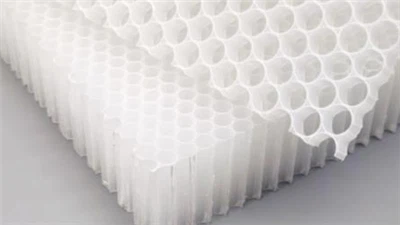
Thermoplastic honeycomb panels are sandwich composite structures consisting of:
- A polypropylene honeycomb core
- Two outer structural skins (varies by application)
The core is built from a hexagonal cellular geometry, which is one of the most efficient load-distribution structures found in nature and engineering.
Instead of relying on solid mass, the structure uses geometric stiffness, where:
- Vertical cell walls resist compression
- Cell geometry distributes stress evenly
- Load is transferred across multiple directions instead of a single failure point
This structural principle is what gives honeycomb panels their unique mechanical behavior.
Strength Is Not Just One Number
When evaluating honeycomb panels, "strength" must be divided into multiple categories:
1. Compressive strength (resistance to vertical load)
2. Shear strength (resistance to sliding deformation)
3. Bending stiffness (resistance to bending under load)
4. Impact resistance (energy absorption under sudden force)
Thermoplastic honeycomb panels perform differently in each category, and their engineering value comes from balanced performance across all four rather than one extreme value.
Industry data shows PP honeycomb cores can achieve MPa-level compressive strength and stable shear performance depending on density and structure design.
Compressive Strength in Industrial Use
In industrial applications, compressive load resistance is critical for:
- Truck flooring systems
- Cargo platforms
- Modular equipment bases
- Storage structures
The honeycomb core resists compression through its vertical cell walls. When load is applied:
- Each cell shares part of the stress
- Force is distributed across a wide area
- Localized collapse is delayed or prevented
Engineering tests show that thermoplastic honeycomb panels can maintain structural stability even under high load conditions due to uniform stress distribution across the core structure.
This is especially important in transport systems where loads are dynamic, not static.
Shear Strength and Structural Stability
Shear strength determines how well a panel resists sideways forces and deformation.
In real industrial environments, shear loads occur in:
- Vehicle acceleration and braking
- Forklift loading and unloading
- Road vibration and torsional stress
- Structural movement in modular systems
The honeycomb structure provides shear resistance by:
- Locking cell walls in a rigid geometry
- Preventing lateral collapse
- Maintaining dimensional stability under repeated stress cycles
Because of this, thermoplastic honeycomb panels are widely used in applications requiring long-term structural stability under vibration and repeated loading.
Bending Strength: The Key Advantage in Lightweight Engineering
One of the most important advantages of honeycomb panels is their bending stiffness relative to weight.
In engineering terms:
Increasing panel thickness dramatically increases bending stiffness without proportionally increasing weight.
This happens because:
- The outer skins carry tensile and compressive stress
- The honeycomb core maintains spacing between skins
- The structure behaves like a deep beam system
This is why honeycomb panels are widely used in:
- Truck side walls
- Rail interior panels
- Marine cabin structures
- Industrial enclosure systems
Studies show that honeycomb sandwich structures achieve high flexural rigidity while maintaining low material density, making them ideal for lightweight design optimization.
Impact Resistance and Energy Absorption
Industrial materials are often exposed to sudden impacts rather than gradual loads.
Examples include:
- Forklift collisions
- Cargo shifting during transport
- Tool impacts in manufacturing environments
- External mechanical shocks
Thermoplastic honeycomb panels absorb impact energy through:
- Controlled deformation of cell walls
- Progressive collapse of internal structure
- Energy distribution across multiple cells
Instead of cracking or breaking suddenly, the structure absorbs and dissipates energy gradually, which improves safety and durability.
This makes them particularly suitable for logistics and transport systems where impact events are frequent.


Why Thermoplastic Honeycomb Panels Perform So Well
The strength of honeycomb panels is not based on dense material mass, but on engineering geometry.
Key advantages include:
- High stiffness with low density
- Stable performance under repeated stress
- Resistance to fatigue in vibration environments
- Predictable mechanical behavior in engineered systems
Unlike solid structures, honeycomb panels are designed to optimize material placement rather than maximize material usage.
Industrial Applications Driven by Strength Efficiency
Because of their mechanical performance, thermoplastic honeycomb panels are widely used in:
🚚 Transportation systems
- Truck body flooring
- Side panels and partitions
- Lightweight cargo structures
🚢 Marine environments
- Interior structures
- Cabin panels
- Lightweight decking systems
🏭 Industrial equipment
- Machine enclosures
- Protective covers
- Modular structural systems
In all these applications, the goal is the same:
Reduce weight without compromising structural integrity.
Key Takeaways
So, how strong are thermoplastic honeycomb panels?
The answer is:
-
Extremely strong in relation to their weight
-
Highly efficient in bending and compression systems
-
Excellent in impact energy absorption
-
Optimized for real industrial load conditions
They are not designed to compete with solid dense materials in raw material strength-but to outperform them in functional structural efficiency.
FAQ
1. Can thermoplastic honeycomb panels be used in structural load-bearing frames?
Thermoplastic honeycomb panels are typically used as structural panels rather than primary load-bearing frames. However, when integrated into engineered sandwich systems, they can effectively contribute to overall structural rigidity and distribute loads within modular assemblies.
2. How do thermoplastic honeycomb panels perform under long-term vibration exposure?
They perform well under continuous vibration conditions due to their internal cellular structure, which helps dissipate mechanical energy and reduce localized stress accumulation. This makes them suitable for transport and mobile industrial environments.
3. Are thermoplastic honeycomb panels affected by repeated mechanical stress cycles?
They are designed to withstand repeated loading cycles without significant structural fatigue. The honeycomb geometry helps maintain stability by spreading stress across multiple cell structures rather than concentrating it in one area.
4. Can thermoplastic honeycomb panels be integrated with different surface materials?
Yes. They are compatible with a wide range of surface laminates and coatings, allowing engineers to customize surface performance based on application needs such as abrasion resistance, chemical exposure, or aesthetic requirements.
5. Do thermoplastic honeycomb panels require special storage or handling conditions?
No special storage conditions are required under normal industrial environments. However, proper handling practices are recommended to avoid edge damage or surface impact during transportation and assembly processes.
Looking for High-Strength Thermoplastic Honeycomb Solutions?
Holycore provides advanced polypropylene honeycomb panel systems designed for industrial applications that require lightweight performance, structural stability, and long-term durability in demanding environments.
Get Instant Quote for Your Project