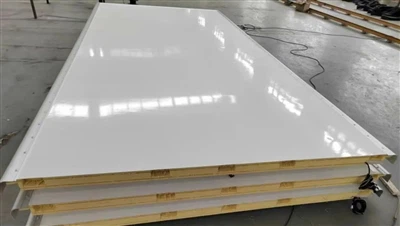
Industrial Structures Require Stiffness Without Excess Structural Mass
Industrial wall systems, equipment enclosures, truck bodies, and modular technical units must resist bending and vibration while remaining light enough for transportation and installation. Traditional solid boards increase stiffness by increasing material thickness and density. This inevitably adds secondary engineering loads:
Holycore honeycomb composite panels use a sandwich structure that separates bending rigidity from solid internal mass. The panel maintains thickness and mechanical resistance through cellular geometry rather than dense filler material.
Honeycomb Composite Panels Use Sandwich Load Distribution
A honeycomb composite panel consists of multiple bonded structural layers.
| Structural Layer | Material | Functional Action |
|---|---|---|
| Outer Skin | FRP / Aluminum / Steel | Resist tensile and compressive force |
| Core Layer | PP Honeycomb | Support panel spacing and transfer shear load |
| Bonding Interface | PU / Epoxy Adhesive | Connect skins to core structure |
PP Honeycomb Structures Resist Moisture Penetration
Wood-based industrial panels gradually absorb water through exposed boundaries, compromised interfaces, and field modifications. Over service life, environmental humidity and water contact initiate localized physical degradation.
Primary Moisture Entry Points:
Resulting Material Degradation:
Holycore PP honeycomb structures leverage closed-cell polypropylene geometry that does not absorb water or transport moisture internally, completely eliminating the structural rot and degradation risks common to plywood or MDF substrates.
This becomes critical in:
|
Operating Environment |
Structural Requirement |
|---|---|
| Refrigerated facilities | Resist condensation |
| Outdoor equipment systems | Resist rain exposure |
| Washable interiors | Resist water penetration |
| Coastal installations | Maintain dimensional stability |
Frequently Asked Questions
Why are honeycomb composite panels lighter than solid panels?
+
-
Honeycomb panels use hollow cellular cores instead of solid internal material. The bonded sandwich structure maintains panel thickness while reducing total weight in truck bodies, equipment housings, and modular structures.
Can honeycomb panels resist moisture exposure?
+
-
Holycore PP honeycomb cores use closed-cell polypropylene structures that do not absorb water like plywood or MDF. This helps reduce swelling, delamination, and edge deformation in humid or washable environments.
What surface materials can be used?
+
-
Holycore can laminate honeycomb cores with:
- FRP skins for washable interiors
- Aluminum skins for lightweight structures
- Steel skins for impact-resistant systems
The skin material is selected according to loading and operating conditions.
Can the panels be CNC-machined before installation?
+
-
Yes. Panels can be CNC-processed for cable routing, ventilation openings, mounting zones, and door frame cutouts before assembly integration.
What affects the service life of a honeycomb composite panel?
+
-
Panel durability mainly depends on bonding stability, edge sealing structure, surface material selection, and operating environment. Improper lamination may cause skin separation or localized core failure under vibration loading.