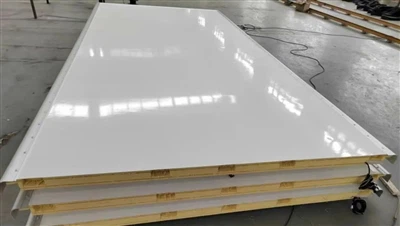
Refrigerated Truck Bodies Fail First at Moisture Penetration Zones
Cold chain truck panels operate under repeated temperature cycling between external ambient air and refrigerated cargo zones. During loading, unloading, and defrost cycles, condensation forms at:
Traditional plywood-core panels gradually absorb water through these exposed regions. After repeated moisture exposure, wood fibers expand and generate:
Holycore thermoplastic honeycomb panels replace absorbent wood substrates with polypropylene cellular cores that resist water penetration during refrigerated transport operation.
Panel Structure Used in Cold Chain Vehicle Systems
A thermoplastic honeycomb panel is a laminated sandwich structure composed of:
| Structural Layer | Material | Functional Action |
|---|---|---|
| Exterior Skin | FRP / Aluminum Sheet | Resist impact and external abrasion |
| Core Structure | PP Honeycomb | Support panel thickness while reducing density |
| Interior Skin | FRP / Thermoplastic Sheet | Form washable cargo-facing surface |
| Bonding Layer | PU or Thermoplastic Adhesive | Transfer shear stress between layers |
The panel does not rely on solid internal mass for rigidity. The honeycomb geometry separates the outer skins and transfers bending force through the bonded sandwich structure.
Why Polypropylene Honeycomb Cores Are Used Instead of Plywood
Plywood cores gradually change dimension when exposed to humidity fluctuation inside refrigerated cargo systems.
Polypropylene honeycomb structures use closed-cell geometry that does not absorb water through capillary fiber action.
This becomes critical in:

| Operating Environment | Structural Requirement |
|---|---|
| Frozen food transport | Resist condensation accumulation |
| Seafood logistics | Resist saltwater contamination |
| Pharmaceutical transport | Maintain hygienic interior surfaces |
| Fresh produce delivery | Reduce internal mold growth risk |
Unlike timber substrates, PP cores do not rot, swell, or soften after repeated wash-down cleaning procedures.
Thermal Transfer Path Directly Affects Refrigeration Load
Cold chain truck bodies continuously exchange heat with the external environment through wall, roof, and floor panels. Solid aluminum or steel wall systems conduct heat rapidly into refrigerated compartments. Honeycomb sandwich structures interrupt this conductive path through internal air cavities.
Heat Transfer Sequence
External skin absorbs ambient thermal load
Honeycomb air cells reduce direct conductive transfer
Bonded internal skins distribute residual thermal energy
Refrigeration unit compensates for lower heat ingress volume
Reducing conductive heat transfer may help **lower refrigeration compressor operating frequency** and minimize fleet energy demands during long-distance transportation cycles.
Panel Bonding Stability Determines Long-Term Structural Integrity
Cold chain vehicles experience continuous vibration during transport. Structural stress concentrates at:
Improper adhesive distribution during panel lamination may generate:
Holycore controls bonding stability through monitored lamination pressure and thermal curing cycles during production.
Holycore Supports OEM Cold Chain Vehicle Manufacturing
Thermoplastic Honeycomb Applications
Holycore supplies thermoplastic honeycomb structures for:
- Refrigerated truck sidewalls
- Roof insulation panels
- Refrigerated door systems
- Mobile freezer units
- Pharmaceutical cold chain bodies
Engineering Support Services
Our technical team provides downstream processing support:
- Panel structure configuration
- Skin material matching
- Edge sealing recommendations
- CNC machining preparation
- Lamination structure adjustment
- Export packaging systems
Request Custom Sample Panels & Technical Documentation
Sample panels and technical documentation can be prepared according to truck body dimensions, operating temperature conditions, and assembly requirements.