Sustainability as a Materials Engineering Objective
Sustainability in engineered products has evolved from a compliance-driven requirement into a core performance metric. For structural systems in transportation, logistics, construction, and industrial equipment, sustainability is no longer assessed solely by material origin or recyclability claims. Instead, it is evaluated across the entire lifecycle, encompassing material efficiency, manufacturing impact, operational performance, durability, repairability, and end-of-life options.
Thermoplastic composites occupy a unique position in this landscape. Unlike traditional thermoset composites or monolithic structural materials, thermoplastic composite systems combine high structural performance with process flexibility and circularity potential. Their sustainability advantages emerge not from a single attribute, but from how material chemistry, structural design, and lifecycle behavior interact at a system level.
Material Efficiency and Lightweighting Impact
One of the most immediate sustainability benefits of thermoplastic composites is material efficiency. These materials enable high strength and stiffness at significantly lower mass compared to metals or solid polymer structures.
Reduced mass translates directly into:
Lower raw material consumption per functional unit
Reduced energy demand during transportation and installation
Lower operational energy use in mobile and transport applications
In vehicle bodies, logistics equipment, and mobile structures, lightweighting has a compounding sustainability effect. Every kilogram removed reduces fuel or energy consumption over the entire service life, often outweighing differences in material production emissions.
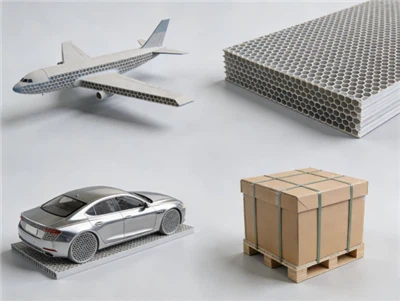
Thermoplastic composites enable this efficiency by allowing engineers to place material only where it is structurally necessary, particularly when combined with sandwich panel architectures.
Thermoplastic vs Thermoset Sustainability Logic
While both thermoplastic and thermoset composites offer performance advantages over traditional materials, their sustainability profiles differ fundamentally.
Thermoset composites rely on irreversible chemical crosslinking. Once cured, they cannot be remelted or reshaped, which limits recycling options and complicates repair and reprocessing.
Thermoplastic composites, by contrast, are based on reversible polymer chains. This distinction enables:
Reheating and reshaping without chemical degradation
Welding and fusion bonding instead of permanent adhesives
Reprocessing into new products at end of life
From a sustainability perspective, this reversibility shifts composites from a linear material model toward a more circular one.
Manufacturing Energy and Process Efficiency
Manufacturing processes contribute significantly to a product's environmental footprint. Thermoplastic composites offer advantages in this area due to their compatibility with efficient, repeatable processing methods.
Key manufacturing-related sustainability benefits include:
Shorter cycle times compared to thermoset curing
Lower reliance on energy-intensive autoclave processes
Reduced scrap rates through reheating and reshaping capability
In high-volume or modular production environments, these efficiencies reduce overall energy consumption and improve yield consistency. Scrap material generated during trimming or forming can often be reprocessed rather than discarded, further reducing waste.
Elimination of Solvents and Hazardous Chemicals
Thermoplastic composite manufacturing typically involves fewer hazardous chemicals than thermoset systems. Thermosets often require resins, hardeners, and solvents that pose health and environmental risks during processing and disposal.
Thermoplastic systems generally avoid:
Volatile organic compound (VOC) emissions from curing reactions
Hazardous waste streams associated with resin handling
Strict environmental controls required for solvent-based processes
Reducing chemical complexity improves workplace safety and lowers the environmental burden associated with regulatory compliance and waste treatment.
Durability and Service Life Extension
Sustainability is closely tied to durability. Materials that fail prematurely or require frequent replacement generate higher lifecycle emissions, regardless of their initial environmental credentials.
Thermoplastic composites offer durability advantages through:
High impact resistance and damage tolerance
Resistance to corrosion, rot, and chemical attack
Stable mechanical properties under cyclic loading
In transport bodies and mobile structures, these properties reduce the frequency of repairs and replacements, extending service life and lowering cumulative resource consumption.
Longer service life also means fewer manufacturing cycles over time, which directly reduces embodied energy and emissions per year of use.
Repairability as a Sustainability Enabler
Repairability is an often-overlooked sustainability factor. Materials that can be repaired efficiently avoid premature disposal and replacement.
Thermoplastic composites support repair-friendly design strategies, including:
Localized reheating and reshaping
Fusion bonding or welding-based repairs
Patch repairs without full component replacement
These capabilities reduce waste generation and downtime, particularly in fleet and industrial applications where operational continuity is critical. By enabling multiple repair cycles without significant performance loss, thermoplastic composites extend the functional lifespan of structural systems.
Integration with Lightweight Core Structures
When combined with honeycomb or other lightweight core materials, thermoplastic composites amplify sustainability benefits. Sandwich panel construction reduces material usage while maintaining or improving structural performance.
Sustainability advantages of this integration include:
Lower overall material mass
Improved thermal and acoustic performance without additional layers
Reduced need for secondary insulation or damping materials
By consolidating multiple functional requirements into a single panel system, thermoplastic composite sandwiches reduce part count, assembly complexity, and associated environmental impact.
Operational Energy Savings in Use Phase
For mobile and transport-related applications, the use phase dominates lifecycle environmental impact. Thermoplastic composites contribute to operational sustainability through weight reduction and functional integration.
Lower vehicle mass leads to:
Reduced fuel or electricity consumption
Lower emissions over millions of kilometers of operation
Increased payload efficiency
These operational savings often exceed the environmental impact associated with material production, making thermoplastic composites particularly attractive from a lifecycle assessment perspective.
End-of-Life Scenarios and Circular Potential
End-of-life treatment remains one of the strongest sustainability arguments for thermoplastic composites. Unlike thermoset-based systems, thermoplastic composites can be mechanically recycled or reprocessed into secondary products.
Potential end-of-life pathways include:
Mechanical grinding and remelting
Reuse in lower-load structural applications
Energy recovery with reduced hazardous residue
While challenges remain in separating fibers and polymers efficiently, thermoplastic systems offer a clearer pathway toward circular material flows compared to irreversible composite technologies.
Design for Disassembly and Modular Sustainability
Thermoplastic composites align well with modular and design-for-disassembly principles. Their compatibility with welding, reversible fastening, and modular panel systems supports structures that can be dismantled, upgraded, or reconfigured.
This modularity enhances sustainability by:
Allowing partial replacement instead of full system disposal
Supporting upgrades without scrapping existing structures
Enabling reuse of panels across multiple service cycles
Such adaptability reduces resource demand over time and aligns with evolving sustainability regulations and circular economy frameworks.
Supply Chain and Material Sourcing Considerations
From a broader sustainability perspective, thermoplastic composites benefit from diversified and scalable polymer supply chains. Many thermoplastic resins are available in recycled or bio-based variants, allowing manufacturers to progressively reduce reliance on virgin fossil resources.
As recycled polymer quality improves and traceability increases, thermoplastic composite systems can integrate higher recycled content without compromising structural performance.
Sustainability as a System-Level Outcome
The sustainability benefits of thermoplastic composites cannot be attributed to a single feature such as recyclability or weight reduction. Instead, they emerge from the interaction of material chemistry, structural efficiency, manufacturing methods, durability, repairability, and end-of-life options.
When evaluated at a system level, thermoplastic composites enable engineers and decision-makers to reduce environmental impact without sacrificing performance or reliability. Their flexibility supports continuous improvement across the product lifecycle, making them a foundational material technology for industries seeking practical, scalable sustainability rather than symbolic gains.