When engineers evaluate panel materials for industrial, construction, or transportation applications, they often compare honeycomb core panels with solid plastic boards (such as PP, PVC, or HDPE sheets).
At first glance, both seem viable: plastic boards are simple and low-cost, while honeycomb panels appear more complex. However, the difference lies in structural engineering philosophy:
Solid plastic boards rely on material thickness for strength
Honeycomb panels rely on structural geometry for efficiency
This distinction leads to significant differences in performance, cost, and application suitability.
Weight vs. Structural Performance
Solid Plastic Boards:
Density is uniform throughout
Weight increases directly with thickness
Limited stiffness unless material is thick
Honeycomb Core Panels:
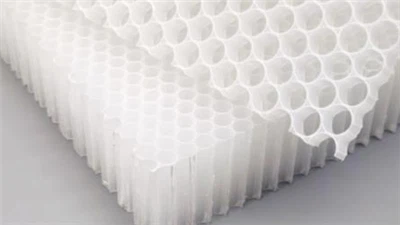
Core contains mostly air (cellular structure)
Face sheets carry load efficiently
Much higher stiffness at lower weight
Engineering conclusion:
Honeycomb panels achieve a superior strength-to-weight ratio.
Holycore perspective:
Holycore's aluminum and thermoplastic honeycomb panels are engineered to deliver high stiffness with minimal mass, making them ideal for weight-sensitive applications.
Bending Stiffness and Load Capacity
Solid Plastic:
Low modulus compared to metals
Prone to bending and deformation under load
Requires increased thickness for stiffness
Honeycomb Panels:
Increased panel thickness without weight penalty
High bending stiffness due to sandwich structure
Better load distribution
Result:
Honeycomb panels can replace much thicker plastic boards while maintaining or exceeding performance.
Material Efficiency
Solid Plastic Boards:
Material is used throughout the entire volume
Much of it contributes little to structural performance
Honeycomb Panels:
Material is concentrated in face sheets
Core provides spacing and shear support with minimal material
Outcome:
Reduced raw material usage
Lower overall weight and cost (in many applications)
Holycore optimizes core density and face sheet combinations to maximize material utilization efficiency.
Impact Resistance and Energy Absorption
Solid Plastic:
Good impact resistance (especially HDPE, PP)
But energy is transmitted directly through the material
Honeycomb Panels:
Cellular core absorbs and dissipates energy
Progressive collapse reduces peak impact forces
Application insight:
Honeycomb panels are better suited for protective structures and transport systems
Holycore panels are widely used in logistics and industrial environments where impact resistance is critical.
Durability and Environmental Resistance
Solid Plastic Boards:
Excellent moisture resistance
UV degradation possible without additives
Honeycomb Panels:
Depends on material combination:
Aluminum honeycomb → corrosion-resistant, non-combustible
Thermoplastic honeycomb → moisture-resistant, recyclable
FRP panels → strong chemical resistance
Conclusion:
Honeycomb panels offer more customizable environmental performance.
Holycore provides multiple material configurations to match different operating environments.
Thickness and Design Flexibility
Solid Plastic:
Limited thickness range
Increasing thickness adds weight quickly
Difficult to achieve large spans without support
Honeycomb Panels:
Thickness can be increased with minimal weight impact
Supports large panel sizes
Enables structural design flexibility
Engineering benefit:
Larger, lighter structures with fewer supports
Functional Integration
Solid Plastic Boards:
Typically single-function (structural or protective)
Additional layers required for insulation or acoustics
Honeycomb Panels:
Multi-functional by design:
Structural strength
Thermal insulation
Acoustic damping
System advantage:
Reduced need for additional materials
Simplified assembly
Holycore panels are often used as integrated solutions rather than standalone materials.
Manufacturing and Processing
Solid Plastic:
Easy to cut, machine, and weld
Suitable for simple fabrication
Honeycomb Panels:
Require more advanced processing
Edge sealing and inserts may be needed
Compatible with modern composite manufacturing methods
Trade-off:
Slightly higher complexity, but significantly better performance
Holycore supports OEM clients with processing-compatible panel designs.
Cost Comparison
Solid Plastic Boards:
Lower upfront material cost
Widely available
Honeycomb Panels:
Higher initial cost
Lower lifecycle cost due to:
Weight savings
Reduced structural requirements
Longer lifespan
Key insight:
Cost should be evaluated at the system level, not just material price.
Holycore offers a balanced cost-performance approach, making honeycomb panels accessible for industrial-scale use.
Typical Application Scenarios
Where Solid Plastic Boards Excel:
Low-load applications
Temporary structures
Cost-sensitive, non-structural uses
Where Honeycomb Panels Excel:
Structural panels
Transportation systems
Industrial equipment
Architectural applications
Holycore's product range is designed to support high-performance, load-bearing, and long-life applications.
Side-by-Side Comparison
| Parameter | Solid Plastic Boards | Honeycomb Core Panels |
|---|---|---|
| Weight | High (for stiffness) | Low |
| Strength-to-Weight Ratio | Low | High |
| Bending Stiffness | Limited | ممتاز (excellent) |
| Material Efficiency | Low | High |
| Impact Performance | Moderate | High |
| Functional Integration | Limited | Multi-functional |
| Cost (Initial) | Low | Moderate |
| Cost (Lifecycle) | Higher | Lower |
Why Engineers Are Shifting Toward Honeycomb Panels
The shift is driven by:
Demand for lightweight structures
Need for higher efficiency
Increasing focus on sustainability
System-level cost optimization
Honeycomb panels are not just a replacement-they represent a more advanced structural solution.
Why Choose Holycore
While many suppliers offer honeycomb or plastic panels, Holycore differentiates itself through:
Integrated Product System
Honeycomb cores + composite panels
Multiple material options (aluminum, thermoplastic, FRP)
Custom Engineering Support
Application-specific design
Load-based optimization
Scalable Manufacturing
Suitable for OEM and industrial projects
Balanced Cost-Performance
Competitive pricing with reliable quality
This makes Holycore a strong partner for companies transitioning from traditional materials to high-efficiency composite solutions.
Conclusion
Honeycomb core panels and solid plastic boards serve different purposes-but for structural and performance-driven applications, honeycomb panels offer clear advantages:
Lower weight
Higher stiffness
Better material efficiency
Greater design flexibility
Solid plastic boards remain useful for simple, low-load applications. However, as engineering requirements become more demanding, honeycomb panels are increasingly the preferred choice.
Final Insight
If your goal is minimum cost per sheet, plastic boards may suffice.
If your goal is maximum performance per kilogram, honeycomb panels-especially those engineered by Holycore-are the superior solution.