Structural Definition
PP honeycomb core is a cellular panel formed from thermoplastic polypropylene sheets bonded at edges into hexagonal cells, with thicknesses ranging from 10 mm to 50 mm and cell diameters from 3 mm to 10 mm.
Aluminum honeycomb core consists of thin aluminum foils, 50–100 µm thick, expanded and bonded into hexagonal cells with diameters of 3 mm to 6 mm, forming panels typically 10–40 mm thick.
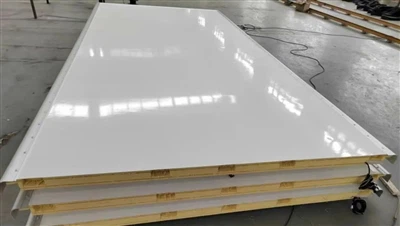
Both materials create sandwich structures when bonded to face sheets, but PP cores achieve stiffness primarily through in-plane shear in plastic walls, whereas aluminum cores transfer compressive and shear loads via metallic cell walls.
Load Transfer Mechanism
In PP honeycomb, applied compression forces are distributed through the hexagonal cell walls, which bend and absorb energy locally while maintaining panel rigidity.
In aluminum honeycomb, cell walls resist bending and buckling under compression and provide higher modulus stiffness.
Shear loads in PP cores induce plastic deformation in cell walls at 50–150 kPa, while aluminum cores transmit shear forces up to 2–5 MPa depending on foil thickness and cell size.
These differences define panel behavior under bending and torsion in lightweight structures.
Material Composition and Fabrication
PP cores are produced from polypropylene sheets, 30–150 µm thick, thermally bonded at 170–200 °C.
Aluminum cores are fabricated from aluminum alloy 3003 or 5052 foils, 50–100 µm thick, expanded mechanically and bonded using adhesive or brazing.
PP cores can include flame retardant additives such as ATH at 5–15 wt% for compliance with UL94 V-0.
Aluminum cores resist temperatures up to 300 °C in dry conditions but may corrode in humid or saline environments unless coated with anodized or polymer layers.
Typical Working Conditions
PP honeycomb panels are used in interior automotive components, lightweight transport containers, and aerospace floor panels, typically under temperatures −20 °C to 80 °C, relative humidity up to 95 %, and compressive loads up to 150 kPa.
Aluminum honeycomb panels are deployed in aerospace structural panels, ship bulkheads, and wind turbine blades, operating under −50 °C to 250 °C, compressive loads 0.5–2 MPa, and shear stress up to 5 MPa.
Failure modes include local buckling in aluminum cores and plastic yielding or delamination in PP cores when adhesive bonding is inadequate.

Integration and Maintenance
PP honeycomb cores are bonded between composite or aluminum face sheets using epoxy or polyurethane adhesives. Alignment of cell orientation is critical to prevent uneven shear distribution. Aluminum cores are integrated similarly, but require attention to foil surface treatment to avoid galvanic corrosion. Routine inspection involves checking for cell wall cracks, adhesive delamination, or panel warping. Replacement requires detaching face sheets, removing the core, and rebonding with the same cell orientation and thickness.
Engineering Implications for Procurement
PP honeycomb cores are suitable for low-to-moderate load panels where weight reduction is critical. Applications include truck and RV interior panels, modular partitions, and cleanroom walls. They operate between −20 °C and 80 °C, transferring shear loads between face sheets while maintaining panel thickness. The thermoplastic structure resists moisture and avoids corrosion, simplifying bonding to FRP, aluminum, or coated steel skins.
Aluminum honeycomb cores provide higher stiffness, compressive strength, and temperature tolerance, making them suitable for aerospace floor panels, marine bulkheads, and industrial enclosures. Depending on alloy and cell geometry, they can operate above 150 °C and withstand compressive or shear loads that would deform polypropylene cores. Surface treatment is required in humid or coastal environments to prevent corrosion.
Panel thickness and structural requirements influence material choice: PP cores allow thicker panels with minimal weight increase, while aluminum cores achieve high stiffness and compressive resistance in thinner configurations. Engineers must also consider failure modes: PP cores can fail via cell wall buckling or delamination, while aluminum cores may experience foil buckling, fatigue cracking, or corrosion if not protected.
Conclusion
PP honeycomb core and aluminum honeycomb are designed for different engineering requirements.
PP honeycomb focuses on lightweight composite panels with moisture resistance and simplified processing, while aluminum honeycomb provides higher stiffness and load-bearing capacity for structural applications.
Material selection should be based on load conditions, operating environment, manufacturing process, and project specifications.
FAQ
1. How do I choose between PP honeycomb core and aluminum honeycomb?
The choice depends on load requirements and operating conditions. PP honeycomb is commonly selected for lightweight panels exposed to moisture, while aluminum honeycomb is often used when higher stiffness, compressive strength, or elevated temperature resistance is required.
2. Which material provides better weight reduction?
Both materials are designed for lightweight sandwich structures. PP honeycomb typically offers lower density, usually ranging from 60–120 kg/m³, making it suitable for applications where minimizing panel weight is a priority.
3. Which core performs better in humid or corrosive environments?
PP honeycomb does not corrode and has low moisture absorption. It is commonly used in truck bodies, marine interiors, and modular building panels where humidity exposure is a design consideration.
4. Is aluminum honeycomb stronger than PP honeycomb?
Aluminum honeycomb generally provides higher compressive strength, shear strength, and stiffness. It is often specified for aerospace components, marine structures, and applications with higher structural load requirements.
5. Which core is easier to process during panel manufacturing?
PP honeycomb can be cut, bonded, and laminated using standard composite panel production methods. Aluminum honeycomb may require additional processing considerations depending on panel design, edge finishing, and bonding requirements.
6. What specifications should buyers compare before making a decision?
Key parameters include core thickness, density, cell size, compressive strength, shear strength, operating temperature range, moisture exposure conditions, and compatibility with face-sheet materials and adhesives. Comparing these factors helps determine which core best matches the intended application.