Why Bond Lines, Not Materials, Define Panel Reliability
In sandwich panel engineering, failures are rarely caused by the intrinsic weakness of face sheets or cores. More often, they originate at the bond line-the thin adhesive layer that transfers load between skins and core. Despite its critical role, bond line integrity is frequently treated as a secondary consideration, assumed to be adequate as long as the correct adhesive is selected.
This assumption becomes increasingly risky as sandwich panels are pushed toward lighter weight, higher stiffness, and more demanding service conditions. In many real-world applications, panels that appear robust on paper fail prematurely due to progressive debonding, interfacial cracking, or adhesive fatigue. These failures are not random. They are strongly influenced by core geometry, which governs how stresses are introduced, distributed, and cycled within the bond line.
Understanding how core geometry affects adhesive performance is therefore essential for engineers designing reliable sandwich structures and for procurement teams evaluating supplier claims.
The Bond Line as a Structural Interface, Not a Glue Layer
It is tempting to view the adhesive layer simply as a bonding agent whose job is to keep components together. In reality, the bond line is a structural interface responsible for transferring shear, resisting peel, accommodating differential deformation, and dissipating energy under cyclic loading.
In a sandwich panel, global bending loads are converted into shear stresses within the core. These shear stresses must pass through the adhesive layer. Any geometric feature of the core that alters shear distribution, local stiffness, or deformation compatibility directly affects the bond line.
When bond lines fail, it is rarely because the adhesive lacks nominal strength. Instead, failure occurs due to stress concentration, fatigue accumulation, or incompatibility between adhesive deformation and core geometry.
How Core Geometry Defines the Adhesive Stress Environment
Core geometry determines how loads flow from the face sheets into the core. Honeycomb cells, foam pores, or corrugated structures create discrete contact regions rather than continuous support. This discontinuity is central to understanding bond line behavior.
In idealized analysis, adhesives are often assumed to experience uniform shear. In practice, stresses are highly non-uniform. Adhesive layers bridge gaps, span unsupported regions, and conform to irregular surfaces. Core geometry controls the size, spacing, and stiffness of these support points, shaping the stress landscape within the bond line.
This means that two panels using the same adhesive and face sheets can exhibit dramatically different bond durability simply due to differences in core cell size, wall thickness, or topology.
Discrete Load Paths and Stress Localization
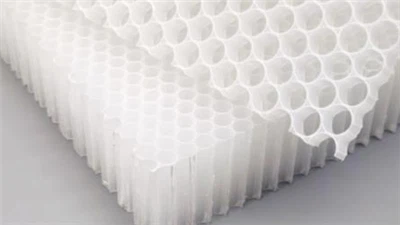
Honeycomb cores offer excellent stiffness-to-weight ratios, but their geometry introduces inherent challenges for adhesive performance. The bond line contacts only the top edges of cell walls, creating a pattern of discrete load transfer points.
Between these points, the adhesive spans open cells, behaving more like a thin membrane than a solid interface. Under bending, these unsupported regions experience higher shear strain and localized peel stress. Over time, this leads to micro-cracking within the adhesive and progressive debond growth.
Smaller cell sizes reduce unsupported spans and improve stress distribution, but they also increase surface area and adhesive consumption. Larger cells reduce material use but amplify stress localization. This trade-off is a core design decision, not an adhesive selection issue.
Cell Wall Thickness and Its Impact on Bond Fatigue
Cell wall thickness influences both local stiffness and adhesive stress amplitude. Thin walls are more compliant, allowing relative movement between face sheet and core. This movement translates into cyclic shear strain within the adhesive layer.
Under repeated loading, even moderate strain amplitudes can lead to adhesive fatigue, particularly in applications involving vibration or thermal cycling. Thicker cell walls reduce deformation but introduce sharper stiffness contrasts, which can increase peel stresses at wall edges.
From a bond integrity perspective, the goal is not maximum stiffness but controlled compatibility between core deformation and adhesive strain capacity.
Foam and Continuous Cores: Apparent Uniformity, Hidden Gradients
Foam cores are often perceived as more "adhesive-friendly" because they provide continuous support. While this is true at a macroscopic level, foam geometry introduces its own challenges at the microscale.
Closed-cell and open-cell foams exhibit variations in cell size, wall thickness, and local density. These variations create stiffness gradients across the bond line. Under load, stiffer regions attract higher stress, while softer regions deform more, generating internal stress redistribution within the adhesive.
In thick panels, these gradients can become significant, leading to localized adhesive overstress even when average shear stress remains low. Engineers who assume uniform adhesive behavior based solely on foam continuity may underestimate long-term debonding risk.
Core Geometry and Peel Stress Generation
Adhesives are generally strong in shear but vulnerable to peel. Core geometry plays a decisive role in peel stress generation, particularly near edges, inserts, and transitions.
Abrupt changes in core geometry-such as cut cells, inserts, or density transitions-force the adhesive layer to accommodate differential bending and rotation. This creates peel stresses perpendicular to the bond line, which are often the initiating factor for debonding.
Honeycomb cores with open edges are especially susceptible. Without proper edge treatment, the adhesive at the perimeter experiences combined shear and peel under even modest loads. Once initiated, peel-driven cracks propagate rapidly along the interface.
The Role of Core Surface Topography in Adhesive Wetting
Beyond structural mechanics, core geometry influences adhesive performance through surface interaction. The topography of the core surface affects adhesive wetting, fillet formation, and effective bond area.
Sharp cell edges may prevent uniform adhesive coverage, creating voids or thin spots that act as crack initiation sites. Conversely, overly rough surfaces can trap air or create resin-rich zones with reduced toughness.
Consistent, well-controlled core geometry enables predictable adhesive thickness and stress distribution. Variability in geometry translates directly into variability in bond quality, which is difficult to detect through standard inspection methods.
Adhesive Thickness: Geometry-Driven, Not Arbitrary
Adhesive thickness is a critical parameter in bond line performance. Too thin, and the adhesive cannot accommodate differential deformation. Too thick, and shear stiffness drops while creep and fatigue increase.
Core geometry largely dictates achievable adhesive thickness. Honeycomb cores naturally create thicker adhesive regions over cells and thinner regions over walls. Foam cores allow more uniform thickness but still reflect local density variations.
Designing for bond integrity therefore requires aligning adhesive properties with the geometry-imposed thickness distribution, not relying on nominal adhesive data.
Thermal Cycling and Geometry-Induced Strain Mismatch
Thermal effects amplify the influence of core geometry on adhesive performance. Different materials expand at different rates. Core geometry determines how this differential expansion is constrained or accommodated.
In honeycomb cores, discrete bonding points concentrate thermal strain into localized adhesive regions. Repeated thermal cycling leads to fatigue damage even in the absence of mechanical load. Foam cores distribute thermal strain more evenly but may experience bulk shrinkage or expansion that stresses the entire bond line.
Ignoring geometry-driven thermal strain is a common cause of unexpected debonding in outdoor or temperature-variable applications.
Manufacturing Tolerances and Bond Line Variability
Core geometry interacts with manufacturing variability in ways that directly affect adhesive integrity. Cell height variation, surface waviness, or incomplete trimming create uneven bond lines with localized stress peaks.
These issues are often invisible in initial inspections but manifest as early-life failures in service. Engineers focusing solely on material specifications may overlook the importance of geometric consistency and process control.
From a reliability standpoint, repeatable geometry is as important as adhesive chemistry.
Implications for Engineering Design Practice
For engineers, the primary lesson is that bond line integrity must be designed, not assumed. This means evaluating core geometry as part of the adhesive system rather than treating it as an independent variable.
Design reviews should consider how cell size, wall thickness, surface finish, and transitions influence adhesive stress states. Where necessary, geometry should be modified to reduce stress concentration, even if this slightly increases weight or cost.
Early collaboration between structural engineers, materials specialists, and manufacturing teams is essential to achieve durable bond lines.
What Procurement Teams Need to Understand About Bond Performance
From a procurement perspective, bond integrity is difficult to evaluate from datasheets alone. Adhesive strength values and core material specifications provide limited insight into long-term performance.
Procurement teams should ask suppliers how core geometry affects adhesive behavior, whether fatigue or thermal cycling tests have been performed, and how geometric tolerances are controlled in production.
Panels with similar nominal specifications can exhibit vastly different bond durability due to subtle geometric differences. Understanding this reality enables better sourcing decisions and reduces lifecycle risk.
Moving Toward Geometry-Aware Bond Design
As sandwich panels are used in increasingly demanding environments, the industry is moving toward more geometry-aware design practices. This includes using simulation tools that model discrete bonding points, conducting panel-level fatigue tests, and specifying geometry-related performance criteria.
These approaches recognize that bond line integrity emerges from the interaction of materials, geometry, and loading-not from adhesive selection alone.
Bond Lines Reflect Design Intent
Bond line failures are rarely accidental. They reflect design choices, often made implicitly, about core geometry and load transfer. By understanding how geometry shapes adhesive performance, engineers can design sandwich panels that not only meet initial specifications but maintain integrity over their intended service life.
In modern sandwich panel engineering, bond line integrity is a geometric problem before it is a chemical one. Recognizing this shift is key to building lighter, stronger, and more reliable composite structures.