FRP XPS sandwich panels have become a critical category of advanced composite materials in a wide range of modern industrial sectors. Combining fiberglass reinforced plastic (FRP) with extruded polystyrene (XPS) foam, these panels deliver high stiffness, superior insulation, corrosion resistance, and lightweight performance. As the demand for durable and high-efficiency composite structures continues to rise in transportation, modular buildings, energy, marine, refrigerated vehicles, and cold-chain logistics, understanding the production process and engineering principles behind FRP XPS sandwich panels is essential for designers, manufacturers, and project engineers.
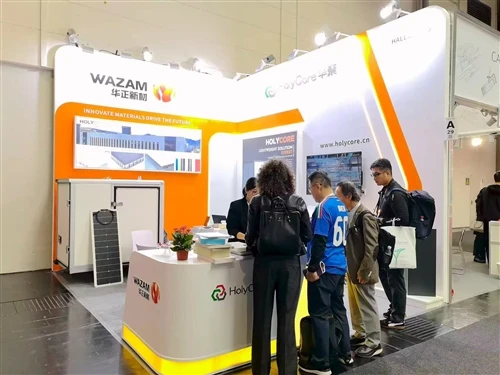
Holycore-a specialist in thermoplastic composite solutions-has developed a refined and stable production system for FRP XPS sandwich panels. Leveraging advanced lamination technologies, high-performance FRP sheets, and precisely engineered XPS cores, Holycore produces panels known for consistency, superior mechanical properties, and long-term durability.
Fundamental Structure of an FRP XPS Sandwich Panel
An FRP XPS sandwich panel consists of three primary layers:
FRP Face Sheets
The face sheets serve as the primary load-bearing surface elements. Holycore uses fiberglass reinforced plastic sheets that combine:
Thermoset resin matrix
Continuous or chopped glass fiber reinforcement
Optional gel coats for UV/chemical resistance
Surface films for protection during transport
Common surface textures include:
Glossy
Matte
Embossed anti-slip
Gel-coated anti-UV surface
XPS Foam Core
Extruded polystyrene (XPS) foam acts as the lightweight structural core providing:
Thermal insulation
Compression strength
Dimensional stability
Low density
Moisture resistance
XPS is a closed-cell foam, which dramatically reduces water absorption and maintains structural integrity over long-term use.
Adhesive Bonding Layer
Holycore uses high-performance adhesives-typically PUR structural adhesive or epoxy film adhesives-to bond FRP skins to the XPS core. Adhesive performance directly influences:
Shear strength
Long-term durability
Impact resistance
Anti-delamination characteristics
Key bonding requirements include uniform glue distribution, controlled curing temperature, and stable pressure.


Material Science Behind FRP and XPS
FRP Sheet Material Science
FRP consists of two core elements:
Resin System
Holycore uses thermoset resin systems such as:
Polyester resin
Vinyl ester resin
Optional fire-resistant resin systems
Properties influenced by resin include:
Chemical resistance
UV resistance
Brittleness or flexibility
Thermal stability
Water absorption
Vinyl ester offers higher chemical resistance and toughness, while polyester provides cost-effective performance for general applications.
Glass Fiber Reinforcement
Mechanical properties of FRP depend heavily on fiber type and orientation:
Chopped strand mat (CSM): isotropic strength, economical
Woven roving (WR): higher tensile and flexural strength
Unidirectional fibers: for specific structural reinforcement
Continuous filament mat (CFM): good surface smoothness
Fiber volume fraction (FVF) directly influences tensile strength and durability.
XPS Core Material Science
XPS is produced through extrusion with blowing agents, resulting in small, uniform closed cells.
Key XPS properties
Closed-cell rate > 95%, enabling low moisture penetration
Consistent compressive strength, ideal for load-bearing applications
Low thermal conductivity, making it widely used in cold-chain systems
Excellent dimensional stability, preventing warping and shrinking
XPS density typically ranges between 28–45 kg/m³ depending on design requirements.
Complete Production Process of Holycore FRP XPS Sandwich Panels
This section describes the industrial production of Holycore's FRP XPS panels, step by step.
Step 1 – FRP Surface Sheet Preparation
Holycore manufactures or selects FRP sheets with the required:
Thickness (0.8–3 mm)
Surface finish
Color stability
UV protection
Preparation processes include:
Surface cleaning to remove dust and release agents
Precision cutting for dimensional accuracy
Optional sanding for enhanced adhesion
Application of gel coats for outdoor UV and chemical protection
Surface quality has a direct impact on bonding, aesthetics, and lifespan.
Step 2 – XPS Core Cutting and Surface Treatment
XPS blocks are selected according to density and compressive strength requirements.
Holycore performs:
CNC trimming for dimensional accuracy
Grooving or perforation if enhanced adhesive penetration is needed
Edge milling to avoid panel wrapping
Inspection of density, cell structure, and compressive strength
Uniform density ensures predictable mechanical response across the panel.
Step 3 – Adhesive Application
Holycore uses controlled adhesive application systems to ensure:
Uniform glue distribution
Strong and consistent bonding
Optimal wet-out of FRP surfaces
Adhesive parameters include:
Temperature
Viscosity
Coating thickness
Open time
Pressing pressure and time
Incorrect adhesive application can cause bubbles, delamination, or weak bonding.
Step 4 – Layer Assembly (Lay-Up)
The panel is assembled in a clean, controlled environment:
FRP → Adhesive → XPS → Adhesive → FRP
This sequence must maintain precise alignment to avoid panel deformation or thickness deviation.
Step 5 – Hot Press or Cold Press Lamination
Holycore uses industrial lamination lines that provide:
Constant pressure across the entire panel
Controlled temperature profiles
Stable curing cycles
Prevention of localized thickness variation
Parameters considered include:
Panel size
Adhesive type
FRP skin thickness
Required structural performance
Step 6 – Cooling, Curing, and Stabilization
After lamination, panels enter a controlled curing zone where the adhesive fully cross-links. Adequate curing ensures:
High shear strength
Resistance to vibration and impact
Dimensional stability
Step 7 – Trimming and CNC Finishing
Panels are cut to final dimensions using CNC equipment:
Straight edges
Custom shapes
Tongue-and-groove profiles
Joint systems
Edge protection profiles
Step 8 – Product Inspection and Testing
Holycore follows rigorous testing procedures:
Mechanical strength test
Shear and peel test
Dimensional flatness inspection
Moisture absorption test
Thermal conductivity measurement
Surface defect inspection
Panels are released only after meeting performance specifications.
Production Defects and Quality Control
Common Defects
Possible defects in FRP XPS panels include:
Delamination
Surface bubbles
Uneven thickness
Core crushing
Bond-line voids
Resin-rich or resin-starved areas
Holycore implements automated detection and manual inspection to ensure panels meet strict standards.
Quality Control Systems
Holycore's quality control includes:
Incoming material inspection
In-process monitoring
Final product testing
Batch tracking
All panels are produced under controlled environmental conditions to avoid moisture interference and bonding issues.
Mechanical Characteristics of Holycore FRP XPS Panels
High Strength-to-Weight Ratio
The combination of FRP skins and XPS core delivers:
High bending strength
High rigidity
Low mass
Excellent energy absorption
This is essential for vehicles and modular buildings.
Superior Thermal Insulation
XPS's closed-cell structure provides exceptional insulation, essential for cold-chain systems and refrigerated vehicles.
Corrosion and Moisture Resistance
FRP skins resist:
Chemicals
Salts
Moisture
Acids
UV exposure (with gel coat)
XPS absorbs minimal water (<1%), ensuring long-term insulation performance.
Impact Resistance
FRP surfaces distribute impact forces efficiently, making the panels suitable for vehicle floors and industrial environments.
Long-Term Dimensional Stability
Even under temperature swings, FRP XPS panels resist:
Warping
Shrinking
Softening
This ensures reliability in outdoor and high-humidity environments.
Comparison with Other Types of Sandwich Panels
FRP XPS vs FRP PP Honeycomb
| Parameter | FRP XPS Panel | FRP PP Honeycomb Panel |
|---|---|---|
| Weight | Slightly heavier | Ultra-lightweight |
| Insulation | Excellent | Moderate |
| Compressive Strength | High | Medium |
| Dimensional Stability | High | High |
| Best Use | Cold chain, vehicles, buildings | Boats, RVs, interiors |
FRP XPS vs FRP PET Core
| Parameter | FRP XPS | FRP PET |
|---|---|---|
| Cost | Lower | Higher |
| Insulation | Better | Lower |
| Heat Resistance | Medium | Higher |
FRP XPS vs Metal Panels
| Parameter | FRP XPS | Metal |
|---|---|---|
| Weight | Much lighter | Heavy |
| Corrosion | No corrosion | Corrodes |
| Thermal Conductivity | Very low | High |
| Maintenance | Minimal | Higher |
Holycore Manufacturing Advantages
Holycore offers several unique advantages:
Advanced Lamination Lines
Ensuring:
Uniform pressure
Controlled curing
Zero thickness deviation
Custom Material Engineering
Options include:
FRP thickness customization
Surface types
Gel coat reinforcement
Fire-resistant resin systems
Flexible Core Options
XPS cores can vary in:
Density
Thickness
Compressive strength
Integration with Holycore Panel Series
Holycore's FRP XPS panels can be combined with:
Holypan® thermoplastic FRP sandwich panels
UDpan® unidirectional composite panels
FRP XPS flooring systems
Strict Quality Assurance System
Including mechanical tests, thermal tests, moisture testing, and dimensional accuracy inspections.
Product Parameters – Holycore FRP XPS Panel Series
Holycore FRP XPS Sandwich Panel Specifications
| Item | Specification |
|---|---|
| FRP sheet | Smooth / Matte / Embossed / Gel Coat |
| Core Material | XPS |
| Panel Thickness | 10–100 mm |
| FRP Skin Thickness | 1–3 mm |
| Density | 450–650 kg/m³ |
| Compressive Strength | 150–300 kPa |
| Thermal Conductivity | 0.028–0.032 W/m·K |
| Water Absorption | < 1% |
| Bonding Strength | ≥ 0.8 MPa |
| Fire Resistance | Optional |
| Standard Color | White or custom |
Detailed Applications of Holycore FRP XPS Sandwich Panels
Cold Chain Logistics
Applications include:
Refrigerated trucks
Freezer container walls
Food storage cabins
Agricultural cold rooms
Reasons for use:
Excellent insulation
Low weight
Moisture resistance
Transportation Industry
Used for:
RV interior walls
Trailer bodies
Bus insulation panels
Marine superstructure modules
Advantages include:
High impact resistance
Good stiffness
Low maintenance
Modular and Prefabricated Buildings
Applications:
Lightweight walls
Ceilings
Cleanroom panels
Prefab houses
Benefits:
Corrosion resistance
Fast installation
High insulation performance
Marine Engineering
Used for:
Cabin interiors
Cold storage compartments
Lightweight partitions
Key benefits:
Saltwater corrosion resistance
Low maintenance
Weight reduction
Cleanrooms and Industrial Facilities
FRP XPS panels are ideal for:
Pharmaceutical rooms
Food processing areas
Electronics manufacturing rooms
Properties include:
Chemical resistance
Hygienic surface
Dimensional stability
Furniture and Decoration
Applications include:
Lightweight furniture panels
Interior partitions
Exhibition booth structures
Advantages:
Easy to cut and shape
Smooth surface finish