In industries ranging from transportation and logistics to construction, vehicle manufacturing, and interior engineering, material selection directly shapes structural performance, operational cost, durability, and long-term value. Traditional building and structural materials-including plywood, solid aluminum, steel, MDF, particle board, and even foam-core panels-have long been standard due to availability and familiarity. Yet they suffer from inherent flaws: excessive weight, low impact resistance, poor moisture stability, high maintenance needs, and limited lifespan.
Holycore honeycomb panels, built on a pure polypropylene (PP) honeycomb core paired with thermoplastic fiberglass or FRP face sheets, address all these pain points while delivering superior mechanical properties. As a lightweight, high-strength composite sandwich structure, Holycore PP honeycomb panels have become a preferred replacement for traditional materials in commercial and industrial applications. This article explains the key advantages that make honeycomb panels a better, more cost-effective, and future-proof alternative, with a focus on Holycore's purpose-engineered product line: Thermoplastic Fiberglass Sandwich Panel, PP Honeycomb Core, FRP Sandwich Panel, Decorative Panel, and Fiberglass Sheet.
1. Exceptional Strength-to-Weight Ratio
The single most compelling advantage of honeycomb panels over traditional materials is their outstanding strength-to-weight performance.
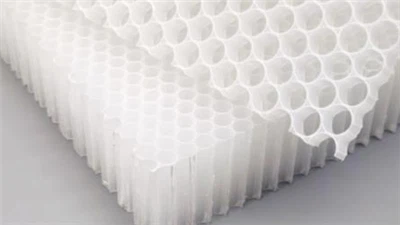
Holycore's PP honeycomb core uses a hexagonal cellular structure that distributes load evenly across the entire panel. When combined with rigid fiberglass or FRP skins, the resulting sandwich panel achieves high flexural strength, compression resistance, and impact tolerance-while remaining significantly lighter than solid materials.
Steel & Aluminum: Solid metal panels offer strength but add substantial weight, increasing fuel consumption in transport and limiting payload capacity.
Plywood & MDF: These materials are dense and heavy without matching composite strength.
Holycore Honeycomb Panels: Up to 60–70% lighter than steel and 40–50% lighter than plywood of equivalent structural rigidity. For truck bodies, trailers, and shipping containers, lower weight directly translates to higher payload, lower fuel costs, and extended range for electric vehicles.
This balance makes honeycomb panels ideal for weight-sensitive industries where strength cannot be compromised.
2. Superior Impact Resistance & Durability
Traditional materials fail catastrophically under repeated or sudden impact:
Plywood splinters, cracks, and delaminates.
Aluminum dents permanently.
Steel bends and requires expensive straightening.
Wood-based products degrade under vibration and load fatigue.
Holycore honeycomb panels absorb impact energy through controlled core deformation rather than transferring stress to the structure. The PP honeycomb core compresses progressively under force, dissipating kinetic energy and resisting punctures, forklift collisions, road debris strikes, and cargo shifting damage.
Unlike metal or wood, Holycore panels:
Resist permanent denting
Maintain structural integrity after repeated impacts
Perform consistently in high-vibration transport environments
Last 2–4 times longer than plywood or conventional paneling
This durability drastically reduces replacement frequency and on-site repairs.
3. Excellent Moisture & Weather Resistance
Most traditional materials struggle with environmental exposure:
Plywood, MDF, and particle board absorb water, swell, rot, and mold.
Metal corrodes, rusts, or oxidizes in humid or outdoor settings.
Foam cores degrade when exposed to moisture or temperature changes.
Holycore uses 100% waterproof polypropylene honeycomb core and fiberglass-reinforced face sheets that are inherently hydrophobic. The panels do not absorb water, resist rotting, corrosion, mildew, and UV degradation, and maintain consistent mechanical properties in wet, cold, or coastal environments.
This stability is critical for:
Refrigerated trucks and cold-chain transport
Outdoor construction panels
Marine and coastal vehicle interiors
Wet industrial environments
Unlike paper or aluminum honeycomb, Holycore PP honeycomb does not degrade when exposed to moisture-making it far more reliable for long-term exterior and heavy-duty use.
4. Low Maintenance & Reduced Lifecycle Cost
Traditional materials demand continuous upkeep:
Plywood requires sealing, painting, or replacement every 2–3 years.
Steel needs anti-corrosion coating and rust repair.
Aluminum panels often require refinishing after denting.
Holycore honeycomb panels are nearly maintenance-free. They:
Do not require painting or sealing
Resist scratches, stains, and chemical exposure
Clean easily with standard detergents
Retain appearance and performance for 8–12 years
Over a vehicle or structure's lifecycle, this reduces maintenance expenses by 60–80% compared to plywood or metal alternatives. For fleet operators and OEMs, this creates measurable long-term savings.
5. Dimensional Stability & Warp Resistance
Wood-based materials warp, twist, and shrink with changes in temperature and humidity. Metal expands and contracts significantly under thermal fluctuation. These dimensional changes lead to misfits, loose fittings, cracked joints, and structural misalignment.
Holycore honeycomb panels exhibit minimal thermal expansion and contraction. The PP core and composite skins maintain flatness, shape, and tolerance even under extreme temperature variations from –40°C to +80°C. This stability ensures consistent fit in truck bodies, wall panels, partition systems, and customized equipment housings.
6. Flexibility in Design & Processing
Honeycomb panels are highly workable compared to rigid traditional materials:
Easy to cut, route, drill, and thermoform
Available in large formats to reduce assembly joints
Can be produced in custom thicknesses, densities, and surface finishes
Compatible with laminating, bonding, and modular assembly
Holycore also offers decorative panels that combine structural performance with aesthetic surfaces, replacing laminates, veneers, and painted wood in vehicle interiors, RVs, vans, and modular buildings.
This design flexibility speeds up production, lowers labor costs, and enables OEMs to create lighter, more aerodynamic, and modern-looking products.
7. Eco-Friendly & Sustainable Profile
Sustainability is increasingly mandatory in global manufacturing and transport regulations. Many traditional materials are either non-recyclable, resource-intensive, or emit harmful substances during production or disposal.
Holycore honeycomb panels:
Use 100% recyclable polypropylene and thermoplastic composites
Generate minimal waste during production
Reduce fuel consumption and carbon emissions through lightweighting
Comply with environmental standards for vehicle and construction materials
Unlike plywood, which relies on timber resources, or PVC and foam materials that are hard to recycle, Holycore honeycomb supports circular economy goals without sacrificing performance.
8.Better Sound & Vibration Damping
In transport vehicles, machinery enclosures, and interior spaces, vibration and noise reduce comfort and accelerate material fatigue. Solid wood and metal transmit noise directly.
Holycore's cellular honeycomb structure naturally dampens vibration and reduces acoustic transmission. This improves ride comfort in trucks, buses, and RVs, lowers operational noise in industrial applications, and extends the service life of structures by reducing fatigue stress.
Why Holycore Honeycomb Panels Stand Out
Not all honeycomb panels are equal. Holycore focuses exclusively on PP honeycomb core and fiberglass-reinforced composite sandwich panels, with no paper or metal honeycomb alternatives. This specialization ensures:
Consistent, industrial-grade structural performance
Full waterproofing and weather stability
Optimized impact resistance for transport and heavy-duty use
Customizable solutions for OEMs, fleets, and fabricators
Stable global supply and reliable B2B support
Holycore's product line-including Thermoplastic Fiberglass Sandwich Panels, FRP Sandwich Panels, Decorative Panels, and standalone Fiberglass Sheets-allows businesses to replace traditional materials across entire projects with a single, trusted material system.
Conclusion
Honeycomb panels are more than just a "modern alternative" to plywood, aluminum, steel, and wood composites-they are a high-performance upgrade that improves every key metric: weight, strength, durability, environmental resistance, maintenance, and lifecycle cost.
For manufacturers, fleet operators, builders, and design engineers, switching to Holycore PP honeycomb panels means:
Higher payload and lower operating costs
Longer-lasting structures with less downtime
Greater design freedom and faster production
Compliance with modern sustainability standards
Superior impact resistance for transport and industrial use
In nearly every heavy-duty, transportation, or interior application, honeycomb panels outperform traditional materials while delivering better long-term value.