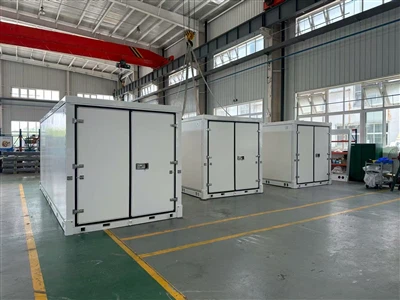
In high-performance engineering applications such as truck bodies, trailers, refrigerated transport, modular vehicles, and structural components, uniform load distribution is critical to avoiding material failure, structural deformation, puncture damage, and premature fatigue. Traditional solid materials like plywood, steel, aluminum, and foam panels often concentrate stress in small areas, leading to cracking, bending, or permanent damage under impact or heavy loading.
Honeycomb structures-especially Holycore's polypropylene (PP) honeycomb core-solve this problem through a naturally optimized geometric design that transforms concentrated loads into widely distributed stress. When integrated into Holycore's sandwich panel system (including Thermoplastic Fiberglass Sandwich Panels, FRP Sandwich Panels, Decorative Panels, and Fiberglass Sheets), this cellular architecture dramatically improves structural stability, impact resistance, and load-bearing efficiency.
This article explains the mechanical principles behind honeycomb load distribution, how Holycore's PP honeycomb enhances performance in transport equipment, and why this structure outperforms traditional materials in real-world working conditions.
1. The Geometric Principle of Honeycomb Load Distribution
A honeycomb structure consists of continuous, regular hexagonal cells that form an interconnected network. This geometry is nature's most efficient design for balancing strength, weight, and load spread.
How Load Spreads Mechanically
When a point load, impact force, or compressive stress is applied to the panel surface, the honeycomb core immediately transfers the force laterally across adjacent cells rather than allowing it to sink vertically into a single area.
Each hexagonal cell shares stress with its neighbors, creating a unified load-bearing network.
The force that would otherwise cause localized damage is dissipated over a much larger area, reducing peak stress to safe levels.
In short, the honeycomb structure turns concentrated force into distributed force-the foundational reason for its exceptional performance.
2. Transforming Point Loads into Uniform Surface Loads
Many failures in transport equipment come from point loads: forklift tines, pallet edges, heavy cargo corners, road debris impacts, and tie-down pressures.
Traditional materials like plywood or solid plastic fail under point loads because stress cannot spread quickly, leading to shear failure, cracking, or denting.
Holycore PP honeycomb distributes point loads radially outward in all directions. Even high-pressure concentrated forces are converted into low-pressure uniform loads across the entire panel section.
This ability is especially important for:
Truck and trailer floors under heavy palletized cargo
Sidewalls impacted by shifting loads
Vehicle corners and high-wear zones
Floor areas subject to rolling or concentrated wheel loads
3. Synergy in Sandwich Panels: Face Sheets + Honeycomb Core
Honeycomb performs best when combined with rigid face sheets-such as Holycore's thermoplastic fiberglass skins or FRP skins. Together, they form a high-efficiency sandwich structure that amplifies load distribution:
Face sheets receive external force and initially spread it across the surface.
Honeycomb core then transfers stress deep into the panel and across its full width and length.
The entire structure acts as one unified beam, resisting bending, buckling, and shear.
Without the honeycomb core, face sheets would bend or rupture under local loads. Without face sheets, the core alone cannot handle external abrasion or impact.
This synergy is why Holycore sandwich panels achieve exceptional strength-to-weight ratios unmatched by plywood, metal, or foam panels.
4. Improved Resistance to Bending, Shear, and Buckling
Uniform load distribution directly improves three key structural behaviors:
Bending Resistance
When a panel bends, one side is in tension and the other in compression. The honeycomb core holds the face sheets at a fixed distance, maximizing the moment of inertia. Load distribution prevents excessive bending and sagging even under long-span unsupported conditions.
Shear Resistance
Shear failure often occurs where stress is concentrated. The interconnected honeycomb cell walls resist shear forces by distributing them throughout the core, preventing layer separation or panel rupture.
Buckling Resistance
Compressive loads can cause thin materials to buckle. Honeycomb structures support face sheets evenly across the entire surface, eliminating weak points and stabilizing the panel under heavy compression.
5. Impact Energy Dissipation Through Controlled Load Spreading
In transport applications, loads are often dynamic-road debris strikes, cargo shifts, vibration, and low-speed collisions.
Honeycomb structures improve load distribution dynamically:
Under sudden impact, cells deform progressively rather than breaking.
Energy is absorbed and distributed across hundreds of cells simultaneously.
Stress waves are slowed, diffused, and neutralized before they can damage the structure or cargo.
Holycore's PP honeycomb is especially effective here because polypropylene's flexibility allows elastic recovery after minor impacts, unlike brittle foam or wood that permanently crushes or splinters.
6. Uniform Load Distribution Reduces Fatigue Failure
Long-haul transport subjects panels to millions of cyclic loads and vibration cycles. Stress concentrations accelerate fatigue cracking and material breakdown.
By maintaining near-uniform stress across the entire panel:
Honeycomb structures eliminate high-stress hotspots.
Material fatigue is significantly delayed.
Panel lifespan increases by 2–4 times compared to plywood or solid panels.
This is critical for fleet operators seeking to minimize maintenance and extend vehicle service life.
7. Why Holycore PP Honeycomb Excels at Load Distribution
Not all honeycomb cores perform equally. Holycore uses 100% polypropylene honeycomb core, with no paper or metal honeycomb, which offers unique advantages for load distribution:
Uniform cell geometry: Consistent hexagonal cells ensure even load transfer with no weak zones.
Flexural toughness: PP cell walls bend and share load instead of snapping.
Lightweight efficiency: Maintains load distribution without adding excess weight.
Moisture stability: Unlike paper honeycomb, PP does not absorb water or degrade, so load distribution performance remains consistent over time.
Chemical & corrosion resistance: Maintains structural integrity in harsh environments.
Holycore's honeycomb is engineered specifically for transport equipment, optimizing cell size and density to balance load distribution, impact resistance, and lightweight performance.
8. Practical Benefits in Transport & Industrial Applications
The improved load distribution of honeycomb structures translates directly to measurable benefits for OEMs, trailer builders, and fleet operators:
Less panel deformation and sagging
Higher payload capacity without structural damage
Greater resistance to forklift impacts and cargo damage
Reduced risk of punctures and sidewall failure
Lighter vehicles with better fuel efficiency or EV range
Longer service life and lower lifecycle costs
More consistent structural performance across extreme environments
Conclusion
Honeycomb structures improve load distribution through a highly efficient hexagonal cellular geometry that spreads concentrated stress across the entire panel, transforming point loads into uniform surface loads. When combined with Holycore's fiberglass or FRP face sheets, this creates a sandwich panel system that excels in bending resistance, shear strength, impact tolerance, and fatigue life.
For manufacturers and engineers building lightweight, durable, high-load transport equipment, Holycore's PP honeycomb panels are not just an alternative material-they are a structurally superior solution that optimizes load behavior while reducing weight and cost.