In today's commercial vehicle industry, OEM manufacturers are under constant pressure to deliver vehicles that carry more cargo, consume less fuel, and comply with increasingly strict emissions and weight regulations.
Get an OEM QuotationWhy Vehicle Weight Matters More Than Ever
Every commercial vehicle has a maximum gross vehicle weight rating (GVWR). The weight of the vehicle itself directly determines how much cargo it can legally transport. Reducing body weight creates several measurable business advantages:
What Makes Honeycomb Panels Different?
Unlike traditional solid sheets, these engineered panels maximize stiffness while minimizing weight via three integrated layers.
The outer skins provide structural strength, impact resistance, and weather protection.
Contains thousands of hexagonal cells that efficiently distribute loads using far less material.
Industrial structural adhesives ensure uniform load transfer and high vibration durability.
Superior Performance Under Real Conditions
Commercial vehicles face continuous mechanical stress: uneven road surfaces, dynamic cargo movement, frequent loading, emergency braking, and twisting forces during cornering. Honeycomb panels resist these forces by distributing loads throughout the entire internal structure rather than allowing localized deformation.
Engineered Internal Resistance Against:
Applications Across Different Vehicle Types
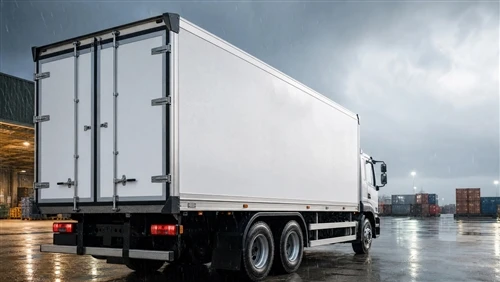
Cargo Trucks & Semi-Trailers
Side walls, roof panels, rear doors, and interior partitions. Reduces non-payload weight to maximize legal freight capacity.
Refrigerated Vehicles
Integrated with polyurethane foam or other insulating materials to cut down thermal transfer and improve refrigeration efficiency.
Recreational Vehicles (RVs)
Commonly specified for exterior walls, floors, furniture structures, and roof systems to boost fuel economy and interior amenities.
Emergency & Specialty Vehicles
Ambulances, fire trucks, and mobile command centers gain structural rigidity while leaving extra weight capacity for critical equipment.
Tailored Solutions Based on Engineering Drawings
Every vehicle platform has unique structural requirements. Standard panel sizes rarely meet all production needs. We offer full-scale custom capabilities:
- ✓ Panel Dimensions: Custom length, width, and thickness parameters. Large-format configurations eliminate joints and simplify assembly.
- ✓ Surface Materials & Finishes: Selection of Aluminum, FRP, Stainless steel, or Composite laminates with powder coating, PVDF coating, or anti-slip textures.
- ✓ Ready-to-Install Machining: Supplied with CNC-cut openings, embedded inserts, edge profiles, mounting holes, and reinforced fastening areas to minimize secondary processing.
Manufacturing Quality Control
Raw Material Inspection
Verification of incoming sheets, cores, and adhesives against strict engineering specifications.
Precision Lamination
Controlled pressure and curing conditions ensure 100% complete bonding and prevent internal voids.
Quality & Tolerance Testing
Every production batch is fully evaluated for panel thickness, absolute flatness, bonding strength, and dimensional tolerance.
Request an OEM Quotation
Evaluate technical factors including load requirements, environmental conditions, and production compatibility with our team.