Core Materials as Structural Decision Points
In sandwich panel construction, the core material plays a decisive role in determining structural efficiency, durability, weight, and long-term operational performance. While face sheets often receive primary attention due to their visible and load-bearing nature, the core governs how loads are transferred, absorbed, and redistributed across the panel system.
Honeycomb, foam, and plywood cores represent three fundamentally different structural philosophies. Each offers distinct advantages and limitations depending on the application context, load conditions, environmental exposure, and lifecycle expectations. Comparing these core types requires moving beyond material cost or tradition and examining how each behaves as part of an integrated structural system.
Structural Mechanics of Core Materials
The core material in a sandwich panel primarily resists shear forces and stabilizes the face sheets against buckling. The effectiveness of this role depends on core stiffness, shear modulus, and geometric stability.
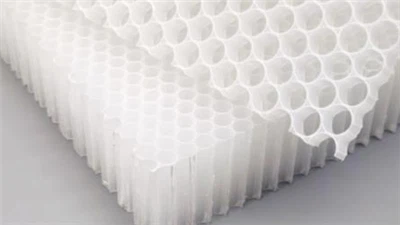
Honeycomb cores derive performance from geometry. Thin cell walls arranged in a regular pattern provide high shear stiffness at low density. Load is distributed through the cellular network, allowing the core to resist deformation efficiently.
Foam cores rely on material continuity rather than geometry. Their shear resistance is provided by the intrinsic stiffness of the foam material, with performance closely tied to density and polymer formulation.
Plywood cores function as quasi-solid materials. Their layered wood structure provides moderate shear strength and good fastener holding capability, but performance scales directly with thickness and mass.


Weight Efficiency and Structural Performance
Weight efficiency is often the primary driver behind core material selection, particularly in mobile and transport-related applications.
Honeycomb cores offer the highest stiffness-to-weight ratio among the three options. By replacing solid material with air while preserving structural pathways, honeycomb cores dramatically reduce mass without proportional loss of mechanical performance.
Foam cores occupy a middle ground. While lighter than plywood, achieving higher stiffness typically requires increased density, which diminishes weight advantages.
Plywood cores are the heaviest option. Their mass contributes little to bending stiffness compared to composite cores, making them less suitable for applications where payload capacity and fuel efficiency are critical.
Load Distribution and Panel Bending Behavior
Under bending loads, the core's ability to maintain face sheet separation is critical.
Honeycomb cores excel in maintaining consistent face spacing under load, resulting in high bending stiffness and predictable deformation behavior. Their geometric structure minimizes localized compression and shear failure when properly specified.
Foam cores provide uniform support but can experience progressive crushing under high localized loads, leading to permanent thickness reduction and stiffness loss.
Plywood cores resist localized loads effectively due to their solid nature but transfer higher stresses into the face sheets, increasing the risk of face cracking or delamination under repeated loading.
Impact Resistance and Damage Tolerance
Impact behavior varies significantly between core types.
Honeycomb cores tend to localize damage. Impact energy is absorbed within a limited region of crushed cells, preserving surrounding structural integrity. This characteristic supports localized repair strategies.
Foam cores absorb impact through material compression, often over a broader area. While this can reduce peak stress, it may result in larger damaged zones that are difficult to repair invisibly.
Plywood cores resist penetration well at low impact energies but can crack or delaminate along grain layers when impact severity increases, potentially propagating damage beyond the initial contact area.
Moisture and Environmental Performance
Environmental exposure is a critical differentiator among core materials.
Honeycomb cores made from thermoplastic or corrosion-resistant materials exhibit strong resistance to moisture and chemical exposure when properly sealed. However, open cell edges require careful treatment to prevent ingress.
Foam cores generally resist moisture absorption, though some formulations can degrade under prolonged exposure to heat, solvents, or UV radiation.
Plywood cores are inherently sensitive to moisture. Even with protective coatings, repeated exposure can lead to swelling, loss of stiffness, and biological degradation, limiting long-term durability in demanding environments.
Thermal and Acoustic Behavior
Thermal and acoustic performance increasingly influence material selection, especially in transport bodies and mobile structures.
Honeycomb cores provide low thermal conductivity due to trapped air, contributing to insulation performance. Their cellular structure also disrupts vibration transmission, supporting noise and vibration control.
Foam cores offer excellent thermal insulation and inherent acoustic damping, particularly in higher-density formulations.
Plywood provides limited thermal insulation and transmits vibration efficiently, often requiring additional layers to meet acoustic or thermal performance targets.
Repairability and Maintenance Considerations
Repairability is a key operational factor, particularly in fleet and industrial applications.
Honeycomb cores support localized repair by allowing damaged sections to be cut out and replaced without affecting the entire panel.
Foam cores can be repaired through filling or patching, though restoring original stiffness can be challenging if damage is widespread.
Plywood repairs often involve replacing entire sections due to moisture damage or internal cracking, increasing downtime and labor costs
Manufacturing and Integration Factors
Manufacturing compatibility and system integration also influence core selection.
Honeycomb cores require precise bonding and edge treatment but integrate well with composite face sheets in high-performance panels.
Foam cores are easy to process and conform to complex shapes, making them suitable for curved or molded components.
Plywood cores are compatible with traditional woodworking and fastening methods but present challenges when integrating with modern composite manufacturing processes.
Sustainability and Lifecycle Considerations
Lifecycle performance extends beyond initial installation.
Honeycomb and foam cores can be engineered for recyclability and consistent long-term performance, particularly when thermoplastic materials are used.
Plywood offers renewable material advantages but often suffers from shorter service life and higher replacement frequency in demanding applications, impacting overall sustainability metrics.
Application-Driven Core Selection Logic
Selecting between honeycomb, foam, and plywood cores requires aligning material behavior with application priorities rather than relying on convention.
Honeycomb cores are favored in high-performance, weight-sensitive, and durability-driven applications.
Foam cores suit applications prioritizing insulation, simplicity, and moderate structural demands.
Plywood remains relevant in low-cost, low-complexity environments where weight and long-term exposure are less critical.
By understanding the structural, environmental, and operational characteristics of each core type, engineers and decision-makers can deploy sandwich panel systems that balance performance, cost, and longevity in a rational and application-specific manner.