For truck manufacturers, vehicle distributors, fleet operators, and regional assembly companies, choosing between a CKD truck body kit and a complete truck body is not simply a purchasing decision. It is a manufacturing and logistics decision that affects transportation cost, labor requirements, inventory management, production flexibility, localization, and long-term fleet economics.
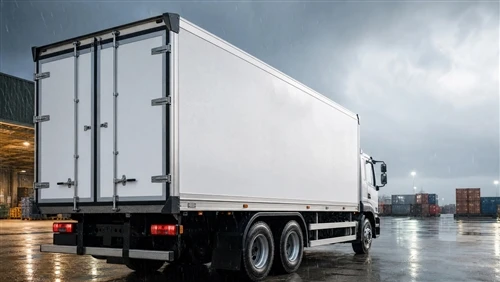
A complete truck body is manufactured and assembled at the supplier's facility before shipment. The buyer receives a finished body that can generally be installed on the corresponding truck chassis with limited additional fabrication.
A CKD, or Completely Knocked Down, truck body takes a different approach. The body is separated into panels, profiles, structural members, doors, flooring components, brackets, fasteners, and other assemblies. These components are packaged and shipped to the destination market, where the body is assembled locally.
Neither model is universally cheaper. The correct choice depends on production volume, shipping distance, local labor costs, available assembly infrastructure, import regulations, body specifications, and the buyer's long-term production strategy.
For a company importing only a few truck bodies, a complete body can remain the simpler and more economical solution. For manufacturers producing hundreds or thousands of units in a regional market, however, CKD supply can create significant advantages by moving part of the manufacturing process closer to the final market.

Understanding the Difference Between CKD and Complete Truck Bodies
The fundamental difference is where final body assembly takes place.
With a complete truck body, most manufacturing activities are performed by the supplier:
Raw materials → panel production → frame fabrication → body assembly → finishing → inspection → shipment → chassis installation
With a CKD body kit, the production chain is divided:
Component manufacturing → inspection → CKD packaging → international shipment → local assembly → chassis installation
This distinction changes the cost structure.
A complete body concentrates labor, equipment, quality control, and assembly operations at the supplier's factory. The customer primarily pays for the finished product and transportation.
A CKD system transfers part of the assembly process to the destination market. The buyer must therefore invest in local labor, assembly tools, jigs, production space, and quality-control procedures.
The economic question is consequently not simply:
"Which body has the lower purchase price?"
It is:
"Which supply model produces the lower total delivered and assembled cost over the intended production volume?"
Initial Purchase Cost Comparison
The first cost category is the supplier's quotation.
A complete truck body normally includes the majority of manufacturing and assembly labor in its selling price. The supplier manufactures the structure, installs the panels, fits doors and hardware, completes sealing, and performs final inspection before shipment.
A CKD kit contains fewer finished assemblies. The supplier manufactures the required components but does not perform the complete final assembly.
As a result, the factory price of a CKD kit can be lower than the price of an equivalent fully assembled body.
However, this difference should not automatically be interpreted as a direct saving.
The CKD buyer may need to pay for:
Assembly workers
Assembly fixtures
Lifting equipment
Hand tools
Torque tools
Riveting equipment
Sealant equipment
Local inspection
Factory space
Training
Initial tooling
Packaging handling
Local inventory management
Therefore, the correct calculation should compare total landed and assembled cost, not only the supplier quotation.
Transportation Cost Is a Major CKD Advantage
Truck bodies are relatively large structures compared with their weight.
A fully assembled body occupies a substantial shipping volume because the roof, side walls, front wall, floor, rear frame, and doors are already positioned in their final three-dimensional configuration.
This can create inefficient container utilization.
A CKD system allows selected components to be stacked, nested, bundled, or packaged in a more compact arrangement.
For example, flat panels can be stacked together, while structural profiles can be bundled according to length. Small brackets and fasteners can be packed inside designated accessory boxes.
The objective is to reduce the ratio of:
shipping volume ÷ finished truck body
This can become increasingly important when the supplier and assembly plant are separated by long international shipping routes.
For high-volume projects, even a modest reduction in shipping cost per body can create a meaningful cumulative saving.
CKD Can Improve Container Utilization
Container utilization is not determined only by total product weight.
Truck body components can reach the container's dimensional limit before reaching its maximum payload limit.
This is particularly relevant for large dry freight bodies.
A complete body may leave considerable unused container volume because its three-dimensional structure prevents efficient stacking.
CKD packaging provides more freedom.
The supplier can design packaging around:
Flat panel dimensions
Profile lengths
Component nesting
Stack height
Protective separators
Hardware boxes
Assembly sequence
This makes packaging engineering part of the CKD project rather than an afterthought.
For buyers comparing quotations, the number of truck body kits per container and the estimated freight cost per finished body are useful commercial indicators.
Labor Cost: The Key Trade-Off
The largest disadvantage of CKD assembly is that the buyer must perform additional work locally.
A complete body requires relatively little assembly after arrival.
A CKD body may require:
Frame positioning
Floor assembly
Side wall installation
Front wall installation
Roof installation
Door installation
Fastening
Sealing
Dimensional inspection
Chassis integration
The actual labor requirement depends heavily on body design and the degree of pre-assembly.
This creates an important cost trade-off.
If local labor is expensive and production volume is low, a complete truck body may be more economical.
If local labor is competitive and production volume is high, CKD can become attractive because assembly costs can be distributed across a dedicated local production line.
The buyer should therefore calculate labor cost per body rather than evaluating labor only as an hourly expense.
Local Manufacturing and Value Addition
CKD systems can support a broader localization strategy.
A company may initially import nearly all body components and perform only final assembly locally.
After production volume increases, the company may begin sourcing selected items domestically.
Potentially localizable components include:
Brackets
Fasteners
Floor materials
Sealing materials
Interior fittings
Certain profiles
Door hardware
Electrical accessories
This creates a gradual transition from imported assembly kits toward a more localized manufacturing operation.
For governments or markets that encourage domestic manufacturing, this can be strategically important.
The exact level of localization must comply with applicable local regulations, customs classifications, certification requirements, and local-content rules.
Complete Truck Bodies Offer Simplicity
Despite the potential cost advantages of CKD, complete truck bodies have several practical benefits.
The supplier handles most production operations.
The customer does not need to establish a dedicated body assembly line or recruit a large assembly workforce.
This is particularly useful when:
Annual production volume is low
The customer has limited manufacturing experience
Local labor costs are high
Factory space is limited
Delivery speed is more important than localization
The customer wants a turnkey solution
A complete body can also reduce coordination complexity.
The buyer receives a finished assembly that has already passed the supplier's production and dimensional inspection procedures.
For companies purchasing only a limited number of vehicles, this simplicity can outweigh potential CKD savings.
CKD Provides Greater Regional Production Flexibility
A CKD system becomes more valuable when the buyer wants to establish a regional production center.
Instead of importing finished bodies for every truck, the company can import standardized kits and assemble bodies according to local chassis specifications.
This can support multiple vehicle configurations.
For example, one regional assembly plant may produce bodies for several truck models by changing:
Body length
Wheelbase interface
Door configuration
Internal fittings
Roof height
Floor specification
Mounting brackets
The core production process can remain standardized.
This provides a balance between product standardization and market-specific customization.
Inventory Management Differences
Complete bodies are finished products.
Once manufactured, they must be stored and transported as large assemblies.
CKD components can provide greater inventory flexibility.
A supplier may manufacture and ship standardized components while the local facility maintains an inventory of common parts.
For example, the same door hardware or corner profile can potentially be used across multiple body configurations.
This can reduce the number of unique spare parts.
However, CKD inventory management also introduces complexity. The assembly plant must ensure that all components belonging to a kit are available when production begins.
A missing bracket or fastener can delay an entire body assembly.
Therefore, CKD programs benefit from:
Bill-of-material control
Barcode or part-number management
Kit identification
Batch tracking
Standardized packaging
Production scheduling
Quality Control: Centralized Versus Local
Complete truck bodies benefit from centralized manufacturing quality control.
The supplier controls the entire assembly process in one facility.
CKD production distributes quality responsibility between supplier and customer.
The supplier controls:
Component dimensions
Material specifications
Surface treatment
Panel quality
Profile geometry
Pre-assembly accuracy
The local plant controls:
Assembly sequence
Fastener installation
Structural alignment
Sealing
Door installation
Final body dimensions
This means the CKD supplier should provide clear assembly drawings, inspection standards, torque specifications, and quality-control procedures.
Without standardized documentation, local assembly quality can vary between production teams.
Maintenance and Spare Parts
CKD architecture can simplify spare-parts planning because the body is designed as a collection of replaceable modules.
A damaged side panel, door component, corner profile, or reinforcement member can potentially be replaced individually rather than replacing an entire finished structure.
This is useful for fleet operators.
Large fleets experience repeated minor damage from loading operations, reversing incidents, urban deliveries, and warehouse impacts.
A modular body system can make repair more systematic.
The fleet operator can maintain commonly required components rather than holding complete replacement bodies.
Lightweight Construction Changes the Cost Equation
Material selection is another important factor in comparing truck body systems.
A lightweight body can use aluminum, galvanized steel, composite panels, sandwich panels, or combinations of these materials.
Reducing structural mass can provide additional payload capacity, but the lowest possible body weight is not always the optimum solution.
A buyer should evaluate:
Payload requirement
Panel stiffness
Floor loading
Impact resistance
Corrosion resistance
Repairability
Expected service life
Material availability
Local fabrication capability
A lightweight CKD body is particularly useful when the buyer wants to combine transportation efficiency with increased payload potential.
However, lightweight construction should be engineered around load paths rather than achieved simply by reducing material thickness.
Which Option Is Better for Fleet Production?
For fleet production, CKD generally becomes more attractive as production volume increases.
A fleet operator producing 10 trucks per year may not justify a dedicated CKD assembly facility.
A regional manufacturer producing 500, 1,000, or more truck bodies annually may have a very different economic equation.
At higher volumes, fixed costs can be distributed across more units.
CKD can also support:
Dedicated assembly lines
Standardized work instructions
Production takt planning
Local workforce development
Regional spare-parts systems
Chassis-specific customization
Higher local value addition
The critical variable is not simply fleet size but repeatable production volume.
If the fleet consists of many highly customized bodies with low repeatability, CKD benefits may be reduced.
CKD vs Complete Truck Body: Key Comparison
| Factor | CKD Truck Body Kit | Complete Truck Body |
| Factory purchase price | Usually lower | Usually higher |
| Shipping efficiency | Generally better | Generally lower |
| Local labor requirement | Higher | Lower |
| Initial tooling | Required | Limited |
| Local assembly facility | Required | Not normally required |
| Localization potential | High | Lower |
| Production flexibility | High | Moderate |
| Low-volume suitability | Moderate to low | High |
| High-volume suitability | High | Moderate |
| Local workforce requirement | Higher | Lower |
| Inventory complexity | Higher | Lower |
| Repair modularity | High | Depends on design |
| Production scalability | High | Moderate |
| Regional manufacturing strategy | Highly suitable | Less suitable |
The table demonstrates why there is no single answer to the question of which model is cheaper.
The answer depends on the complete production system.
Questions Buyers Should Ask Suppliers
Before selecting a CKD or complete-body solution, buyers should request detailed technical and commercial information.
Important questions include:
What components are included in the CKD kit?
What components are pre-assembled?
How many kits can fit into one shipping container?
What is the estimated shipping volume per body?
What assembly equipment is required?
How many workers are required per assembly station?
How long does one body take to assemble?
Are assembly jigs included?
Are detailed assembly drawings provided?
Are spare parts standardized?
What materials are used for panels and structural members?
What is the finished body weight?
What payload is the structure designed for?
How are chassis mounting interfaces defined?
What inspection procedures are recommended?
Can the body be customized for different chassis models?
What is the minimum production quantity?
Can the supplier support long-term fleet production?
These questions reveal the real cost and technical implications of the two supply models.
How to Choose the Right Supply Model
A complete truck body is generally more suitable when the buyer prioritizes:
Low initial investment
Fast deployment
Low production volume
Minimal local assembly
Simple procurement
Turnkey delivery
A CKD truck body kit is generally more suitable when the buyer prioritizes:
High production volume
Lower logistics cost
Local assembly
Regional manufacturing
Product customization
Local workforce utilization
Long-term fleet production
Potential localization
For many commercial vehicle projects, the most practical approach is to calculate both models over the expected production lifecycle.
The first-year cost and five-year cost may produce very different conclusions.
Conclusion
The comparison between a CKD truck body kit and a complete truck body should be based on total cost of ownership and production economics, not factory purchase price alone.
A complete body transfers most manufacturing responsibilities to the supplier. It requires less local infrastructure and is usually easier to deploy, making it suitable for low-volume or turnkey vehicle programs.
A CKD body transfers final assembly to the destination market. This introduces local labor, tooling, quality-control, and inventory requirements, but it can reduce shipping volume, support regional manufacturing, improve customization flexibility, and distribute fixed setup costs across large production volumes.
For small orders, the simplicity of complete truck bodies can outweigh their higher logistics costs. For sustained fleet production, CKD can provide a stronger economic model because the buyer gains control over local assembly and can spread tooling and infrastructure investments across many units.
The most reliable purchasing decision therefore starts with a landed-cost model covering the complete chain:
Kit or body price + freight + customs and duties + handling + labor + tooling + assembly + inspection + inventory + maintenance + expected production volume.
Once these variables are quantified, the break-even point between CKD and complete truck body supply becomes much clearer. For manufacturers planning long-term regional assembly, a well-engineered CKD system can be more than a cost-saving option-it can become the foundation for localized truck body production and scalable fleet manufacturing.