Why the Panel Choice Defines Your Truck Body
Lightweighting is no longer optional for commercial vehicle builders. Every kilogram removed from a truck body translates directly into higher payload, lower fuel consumption, and reduced emissions. At the center of this equation sits one decision: the panel material. For manufacturers specifying lightweight truck body panels, the choice usually narrows to two families of composite sandwich structures - thermoplastic composite panels and thermoset composite panels.
Both deliver the stiffness-to-weight advantage that traditional steel and aluminum cannot match. But they behave very differently in production, repair, recycling, and service life. This guide breaks down the differences so fleet engineers, body builders, and procurement teams can specify with confidence.
What Is a Composite Sandwich Panel?
A composite sandwich panel is a three-layer structure: two thin, high-strength skins bonded to a lightweight core - commonly a honeycomb or foam. The core resists shear; the skins carry bending loads. The result is a panel with exceptional rigidity at a fraction of the weight of solid metal.
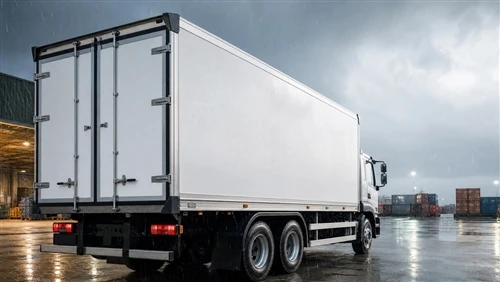
In truck body applications, sandwich panels form walls, roofs, and floors for dry freight boxes and refrigerated units. The core and skin chemistry is what separates thermoplastic from thermoset systems.
Thermoplastic Composite Panels: Recyclable and Reformable
A thermoplastic composite panel uses skins and a core made from polymers that soften when heated and re-harden when cooled - without chemical cross-linking. Typical matrices include polypropylene (PP), polyethylene terephthalate (PET), and glass-fiber-reinforced thermoplastics such as CFRT (continuous fiber-reinforced thermoplastic).
Key characteristics
Fully recyclable. Off-cuts and end-of-life panels can be remelted and reprocessed, supporting circular-economy and ESG targets.
Weldable and repairable. Damaged sections can be hot-air welded or patched on-site, reducing downtime.
Formable. Panels can be thermoformed into curved or complex shapes with standard heating equipment.
Low moisture absorption. Ideal for humid or wash-down environments.
Holycore thermoplastic options
HolyPan - a thermoplastic honeycomb sandwich panel with glass-fiber skins, engineered for truck body walls and floors.
CFRT PET Panel - a continuous-fiber-reinforced thermoplastic panel combining high impact strength with recyclability.
Thermoplastic systems are the natural fit where sustainability mandates, repairability, and modular CKD assembly are priorities.
Thermoset Composite Panels: Rigid and Temperature-Stable
A thermoset composite panel uses resins - such as polyester, vinylester, or epoxy - that cure through irreversible cross-linking. Fiberglass-reinforced plastic (FRP) is the most common form in truck body building.
Key characteristics
High dimensional stability at elevated temperatures. Cross-linked resins resist creep under heat better than many thermoplastics.
Excellent chemical and UV resistance. Well suited to harsh exterior exposure.
Established supply chain. FRP tooling and labor are widely available globally.
Lower raw-material cost per square meter in many commodity grades.
Holycore thermoset options
FRP XPS Panel - fiberglass skins over an XPS foam core, a proven insulation solution for refrigerated bodies.
FRP Honeycomb Panel - fiberglass-reinforced skins bonded to a polypropylene honeycomb core for lightweight rigidity.
FRP Sheet - flat glass-fiber sheet for linings, kick-plates, and secondary structures.
Thermoset panels remain the default where proven temperature performance and lowest initial cost dominate the specification.
Thermoplastic vs Thermoset: Head-to-Head Comparison
| Criterion | Thermoplastic Panel | Thermoset (FRP) Panel |
|---|---|---|
| Recyclability | Fully recyclable, remeltable | Limited; grinding only |
| On-site repair | Hot-air weld / patch | Cut-and-bond, less seamless |
| Temperature stability | Good up to ~80–100°C | Higher continuous-service range |
| Weight | Lower (PP/PET based) | Slightly higher |
| Upfront cost | Higher material cost | Lower commodity cost |
| Formability | Thermoformable | Fixed after cure |
| Moisture absorption | Very low | Low to moderate |
| Best for | CKD kits, green fleets, repair-focused ops | Cost-sensitive, high-heat exposure |
How to Choose for Your Truck Body
The right answer depends on how the body is built, used, and retired.
Choose thermoplastic when…
You operate CKD truck body kits and need panels that assemble, disassemble, and ship flat without damage.
Your fleet commitments include recyclability or carbon-reduction targets.
Field repair speed matters - remote operators benefit from weldable panels.
You build refrigerated or humid-environment bodies where low moisture uptake protects insulation performance.
Choose thermoset when…
Upfront budget is the primary constraint and volumes are stable.
The body sees sustained high-surface-temperature exposure beyond thermoplastic limits.
You rely on a local FRP supply and fabrication network with mature tooling.
The hybrid reality
Many modern bodies are not purely one or the other. A common specification pairs a thermoplastic honeycomb wall (HolyPan) with FRP liners in high-abuse zones - capturing recyclability where it matters and durability where it is needed.
Application Notes for Body Builders
Dry freight boxes: Thermoplastic honeycomb panels deliver the lightest walls and fastest CKD assembly.
Refrigerated units: FRP XPS panels offer proven insulation; thermoplastic skins reduce long-term moisture ingress.
Floors: Higher-density thermoplastic or reinforced FRP grades resist forklift and load wear.
Conclusion: Match Material to Mission
There is no universal winner between thermoplastic and thermoset composite panels - only the right match for your truck body's duty cycle, budget, and sustainability goals. Thermoplastic systems lead on recyclability, repairability, and lightweight CKD assembly. Thermoset FRP leads on upfront cost and high-temperature stability.
Holycore supplies both families - from HolyPan and CFRT PET thermoplastic panels to FRP XPS, FRP Honeycomb, and FRP Sheet thermoset solutions - so specifiers can optimize per application rather than compromise.
Ready to specify? Contact the Holycore engineering team for sample panels, technical datasheets, and a tailored material recommendation for your next truck body program.