Introduction
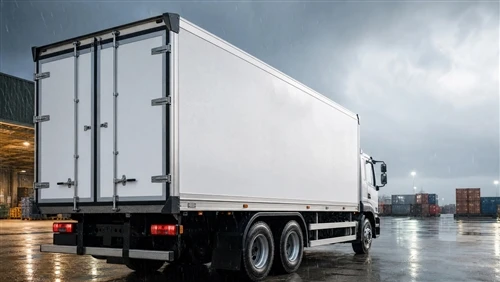
The commercial vehicle industry is increasingly adopting CKD (Completely Knocked Down) truck body systems as a practical method for combining centralized component manufacturing with local vehicle assembly. Instead of importing a fully assembled truck body, an assembly company receives the body as a controlled set of disassembled components and completes the final assembly in the destination market.
This approach is particularly relevant for countries where governments encourage local manufacturing, where imported complete vehicles or assembled bodies carry higher duties, or where truck manufacturers want to establish regional production capacity without investing immediately in complete body fabrication lines.
A CKD truck body kit can include the floor structure, side panels, front wall, roof, rear doors, corner posts, mounting brackets, hardware, seals, reinforcement profiles, and other body components. The exact kit configuration depends on the target truck, local assembly capability, import regulations, and required degree of localization.
The economic advantage of CKD production should not be evaluated simply by comparing the invoice price of a complete body with the price of a kit. The actual cost structure includes import duties, freight volume, local labor, assembly equipment, packaging, inventory, tooling, quality control, localization requirements, and after-sales support.
A properly engineered CKD program therefore aims to create a balance between import cost reduction, local value addition, assembly efficiency, product consistency, and vehicle durability.

What Is a CKD Truck Body Kit?
A CKD truck body kit is a complete set of truck body components supplied in a disassembled condition for final assembly at another location.
The basic concept is:
Component Manufacturing → CKD Packing → International Shipment → Local Assembly → Chassis Integration → Final Inspection
A typical kit may contain:
|
Component |
Typical Function |
|
Floor frame |
Main load-bearing structure |
|
Floor panel |
Supports cargo |
|
Side walls |
Encloses cargo space |
|
Front wall |
Protects cargo and completes enclosure |
|
Roof |
Weather protection |
|
Corner posts |
Connect major structural sections |
|
Rear doors |
Loading and unloading |
|
Door frame |
Supports door loads |
|
Mounting brackets |
Connect body to chassis |
|
Reinforcement profiles |
Improve structural stiffness |
|
Seals |
Control water and dust ingress |
|
Fasteners |
Component connection |
|
Hardware |
Door and body operation |
Not every customer needs exactly the same configuration.
A supplier may provide completely disassembled components, partially assembled modules, or a combination of both.
The correct configuration depends on how much manufacturing and assembly work the destination facility intends to perform.
Why Local Assembly Can Reduce Import Costs
One of the primary reasons for adopting CKD production is the possibility of changing the customs and manufacturing structure of the vehicle program.
A completely assembled truck body can have a different customs classification and import-duty structure from a shipment of individual components. However, actual duty treatment is determined by the regulations and tariff classification of the destination country, so the economic model must be verified with local customs specialists before the project begins.
The potential cost structure can be considered as:
Total Landed Cost = Component Cost + Freight + Duties/Taxes + Local Assembly + Handling + Quality Control
A CKD program attempts to optimize this total rather than focusing only on component purchase price.
For some markets, the reduced value or volume of imported finished goods can provide an economic advantage. In other markets, the main benefit may instead come from local value addition, transportation efficiency, or the ability to use local labor.
Therefore, CKD should be treated as a manufacturing and supply-chain strategy, not simply a packaging method.
CKD vs. Fully Assembled Truck Body
The difference between the two models is substantial.
|
Factor |
Fully Assembled Body |
CKD Body Kit |
|
Export condition |
Complete body |
Disassembled components |
|
Local assembly |
Limited |
Required |
|
Shipping volume |
Higher |
Potentially optimized |
|
Local labor |
Lower |
Higher |
|
Local manufacturing value |
Lower |
Higher |
|
Customization |
More limited after shipment |
Easier during local assembly |
|
Assembly equipment |
Minimal |
Required |
|
Import structure |
Finished product |
Components |
|
Production scalability |
Centralized |
Regional assembly |
|
Localization potential |
Limited |
Higher |
Neither model is automatically cheaper.
CKD becomes attractive when the savings from logistics, import structure, localization, and regional production outweigh the additional cost of local assembly.
Local Assembly Changes the Production Model
In a traditional truck body manufacturing process, most operations are completed at one factory.
In a CKD system, manufacturing responsibilities are divided between two locations.
Supplier Factory
The supplier may perform:
Material preparation
Panel forming
Profile fabrication
Welding
Surface treatment
Component inspection
Hardware preparation
CKD packaging
Destination Assembly Plant
The local facility may perform:
Component receiving
Kit inspection
Floor assembly
Wall installation
Roof installation
Door installation
Sealing
Chassis mounting
Final inspection
This division allows the assembly company to focus on final integration rather than establishing a complete metal fabrication operation from the beginning.
Designing the Kit Around Local Assembly Capability
A CKD kit should be designed according to the capabilities of the destination factory.
A company with limited equipment may prefer highly finished components.
For example, the supplier can provide:
Pre-cut panels
Pre-drilled components
Pre-welded subassemblies
Pre-finished surfaces
Complete door assemblies
A more developed truck assembly plant may prefer a higher degree of local manufacturing.
It may receive:
Flat panels
Structural profiles
Raw reinforcement members
Hardware
Technical drawings
and perform more fabrication locally.
Therefore, CKD is scalable.
The degree of knock-down can be adjusted according to the customer's localization strategy.
Reducing Transportation Volume
Transportation efficiency is another important consideration.
A completed box body has a large dimensional envelope but relatively low mass compared with many industrial products.
Shipping the complete body can therefore result in inefficient utilization of container space.
Disassembled components can potentially be:
Nested
Stacked
Bundled
Protected with separators
Grouped according to assembly sequence
This can reduce unused shipping volume.
However, packaging should never compromise component quality.
Large panels need protection against:
Bending
Scratching
Edge deformation
Moisture
Surface contamination
The packaging engineer should therefore work together with the body engineer.
Structural Components of a CKD Truck Body
A properly designed CKD body should maintain structural integrity after assembly.
The major load path generally follows:
Cargo → Floor → Cross Members → Mounting Brackets → Chassis
Additional loads are transferred through:
Roof → Side Walls → Corner Posts → Floor Structure
The rear door frame also creates a significant structural interface because the rear wall contains a large opening.
For this reason, a CKD body should not be treated as a collection of independent panels.
The components must be engineered as an integrated structure.
Floor Structure and Local Assembly
The floor is normally one of the most important structural assemblies.
Its design depends on:
Cargo weight
Cargo distribution
Pallet loading
Forklift operation
Hand trolley usage
Loading frequency
Chassis mounting configuration
A local assembly plant needs clear information about floor-frame geometry.
Critical dimensions can include:
Overall length
Overall width
Cross-member spacing
Diagonal dimensions
Mounting-hole positions
Floor height
Assembly fixtures can be used to maintain dimensional consistency.
This is especially important when production increases from tens to hundreds or thousands of units.
Side Wall and Roof Components
Side walls and roofs provide enclosure and environmental protection while contributing to body stiffness.
Possible materials include:
Painted steel
Galvanized steel
Aluminum
Composite panels
Sandwich panels
Material selection should consider:
Weight
Strength
Corrosion resistance
Cost
Local repair capability
Manufacturing process
Climate
For example, aluminum can reduce tare weight, while galvanized steel can provide a practical combination of cost and corrosion protection.
Composite panels can be useful when low weight and corrosion resistance are important.
The supplier should avoid choosing materials solely according to initial material price.
Door Systems Must Be Assembly-Friendly
Rear and side doors are frequently operated components.
A CKD door system may include:
Door leaves
Hinges
Locking rods
Handles
Latches
Seals
Door frames
Reinforcement members
The local assembly process should allow door alignment to be adjusted without extensive rework.
Important final inspection parameters include:
Door opening dimensions
Door gap
Hinge movement
Lock engagement
Seal compression
Closing force
A door that cannot be adjusted properly after assembly can become a significant source of field complaints.
Chassis Mounting Is a Critical Interface
The body cannot be designed independently from the truck chassis.
Important chassis interface data includes:
Frame width
Frame height
Wheel position
Axle location
Suspension movement
Exhaust clearance
Fuel-system clearance
Mounting-hole locations
Cab clearance
The supplier should obtain accurate chassis drawings before finalizing the body.
For customers using several truck chassis, a modular mounting system can be developed.
The main body remains standardized while different mounting brackets adapt it to different chassis platforms.
This can reduce engineering and inventory complexity for multi-model assembly programs.
Standardization Helps Reduce Local Assembly Costs
The economic benefit of CKD does not come only from import savings.
Standardization can also reduce assembly cost.
If several truck models share common components, the assembly plant can standardize:
Fasteners
Door hardware
Sealing materials
Floor components
Wall profiles
Corner posts
Assembly tools
Inspection procedures
This reduces the number of unique components that need to be stored.
A modular design can also allow the same basic body architecture to support different:
Body lengths
Body heights
Door configurations
Chassis mounting systems
Interior layouts
This is particularly useful for fleet production.
Assembly Fixtures Improve Production Consistency
Manual assembly can create variation between vehicles.
For low production volumes, this may be acceptable.
For larger production programs, fixtures become increasingly important.
A fixture can establish repeatable reference points for:
Floor alignment
Wall position
Corner-post position
Roof height
Door opening
Overall body width
The result is a more standardized body geometry.
Fixtures also reduce dependence on individual operator judgment.
For an international assembly company, this can make technical training easier because operators follow defined reference points rather than relying entirely on experience.
CKD Quality Control Requires Two-Level Inspection
Quality control must occur both before shipment and after local assembly.
Factory-Level Inspection
The CKD supplier should inspect:
Material specification
Component dimensions
Weld quality
Surface treatment
Hole positions
Component quantity
Hardware
Packaging
Local Assembly Inspection
The destination factory should inspect:
Body dimensions
Floor alignment
Wall verticality
Roof alignment
Door operation
Sealing
Chassis mounting
Exterior appearance
This two-stage inspection system makes it easier to determine whether a problem originated during manufacturing, transportation, or assembly.
Component Identification and Bill of Materials
A CKD project can contain hundreds of individual components.
Without an effective identification system, local assembly becomes inefficient.
A standardized bill of materials should identify:
Part number
Component name
Quantity
Material
Finish
Package number
Assembly location
For example:
|
Part No. |
Component |
Qty. |
Assembly Area |
|
FL-001 |
Floor frame |
1 |
Floor |
|
FL-002 |
Floor panel |
1 |
Floor |
|
SW-L-001 |
Left side wall |
1 |
Left wall |
|
SW-R-001 |
Right side wall |
1 |
Right wall |
|
RW-001 |
Front wall |
1 |
Front |
|
RF-001 |
Roof panel |
1 |
Roof |
|
RD-001 |
Rear door assembly |
1 |
Rear |
|
BR-001 |
Chassis bracket |
8 |
Mounting |
This information can be linked directly to assembly drawings and spare-parts management.
Packaging According to Assembly Sequence
Packaging should be designed around the actual assembly workflow.
One practical approach is to divide the kit into modules:
Package 01 - Floor System
Package 02 - Wall System
Package 03 - Roof System
Package 04 - Rear Door System
Package 05 - Hardware and Sealing Materials
This arrangement reduces component searching during assembly.
It also makes inventory verification easier.
Before beginning assembly, operators can verify each package against the bill of materials.
For large-scale projects, barcode or QR-based component identification can further improve inventory control.
Surface Treatment for International Markets
The destination market should influence the surface treatment specification.
For tropical markets, moisture resistance may be a major consideration.
For coastal markets, chloride exposure can accelerate corrosion.
For desert markets, UV radiation and dust become more significant.
Common protection systems include:
Galvanized steel
Powder coating
Primer + topcoat
Protective sealants
The supplier should also consider corrosion at interfaces between different materials.
For example, aluminum and steel connections may require appropriate isolation to reduce galvanic corrosion.
Local Assembly and Workforce Requirements
One potential advantage of CKD production is the ability to create local assembly operations using a relatively controlled manufacturing process.
However, local assembly does require:
Trained operators
Assembly fixtures
Lifting equipment
Hand tools
Torque tools
Sealant equipment
Inspection equipment
The supplier should provide assembly documentation covering:
Assembly sequence
Fastener specifications
Torque requirements
Sealant application
Adjustment procedures
Inspection checkpoints
This reduces the learning curve during production launch.
Import Cost Analysis Should Consider the Entire Supply Chain
A common mistake is to assume:
CKD component price < complete body price = lower total cost
The actual calculation is more complex.
A useful project-level model is:
Total CKD Cost = Component Cost + International Freight + Customs Duties/Taxes + Local Labor + Assembly Equipment + Packaging + Inventory + Quality Control + After-Sales Support
The customer should compare this against:
Total CBU/Complete Body Cost = Finished Body Price + Freight + Applicable Duties/Taxes + Handling + Local Integration
The exact result depends on the target country.
Import duty classification, local tax treatment, labor cost, freight rates, and localization incentives can significantly affect the final economics.
Therefore, a CKD project should be evaluated using a landed-cost model, not just the supplier's quotation.
CKD Can Support Local Manufacturing Development
Local assembly can gradually develop into a broader manufacturing program.
The production stages may evolve as follows:
Imported CKD Components
↓
Local Body Assembly
↓
Local Hardware and Accessory Integration
↓
Local Panel or Floor Manufacturing
↓
Higher Local Content
This staged approach allows a company to begin with a relatively controlled production process and increase localization as production volume and technical capability grow.
It also allows the company to identify which components are economically suitable for local production.
Prototype Validation Before Mass Production
Before committing to a large CKD program, prototype assembly is highly recommended.
A typical development process includes:
Step 1 - Chassis Definition
Confirm the exact chassis model and dimensional interface.
Step 2 - Body Engineering
Develop floor, wall, roof, door, mounting, and reinforcement systems.
Step 3 - CKD Breakdown
Determine which components will be manufactured overseas and how they will be packaged.
Step 4 - Prototype Production
Manufacture a limited number of kits.
Step 5 - Local Assembly
Assemble the body at the destination facility.
Step 6 - Assembly Validation
Evaluate:
Component fit
Assembly time
Tool requirements
Dimensional accuracy
Door operation
Chassis compatibility
Step 7 - Design Modification
Correct problems identified during assembly.
Step 8 - Pilot Production
Produce a controlled batch.
Step 9 - Fleet Validation
Evaluate the vehicles under representative operating conditions.
Only after these stages should a large-scale CKD production program be finalized.
Typical Applications
CKD truck body systems can support different commercial vehicle applications.
General Freight
For packaged goods, industrial products, and distribution cargo.
Logistics and Parcel Delivery
Requires lightweight construction, high-frequency door operation, and durable floors.
Retail Distribution
Often requires optimized internal dimensions and easy loading.
Agricultural Transport
Requires corrosion protection and resistance to moisture and mud.
Construction Support
May require reinforced floors and impact-resistant panels.
Municipal Fleets
Can incorporate service doors, tool storage, electrical equipment, and customized interior systems.
The same basic CKD architecture can be adapted for different applications through modular components.
How to Select a CKD Truck Body Kit Supplier
International assembly companies should evaluate suppliers across several dimensions.
Engineering
Can the supplier provide complete body drawings and chassis interface designs?
Manufacturing
Can the supplier maintain stable component dimensions across production batches?
Materials
Can the supplier control material grade, thickness, and surface treatment?
CKD Packaging
Can the supplier optimize package dimensions without damaging components?
Assembly Support
Can the supplier provide assembly manuals, fixtures, and technical training?
Quality Control
Does the supplier have defined inspection checkpoints and traceable production records?
Customization
Can the supplier adapt the kit to different chassis, body dimensions, and applications?
Spare Parts
Can the supplier continue supplying replacement components after the original production batch?
Production Scalability
Can the supplier support prototype, pilot, and mass-production stages?
These factors have a greater impact on long-term CKD project performance than the initial component price alone.
CKD as a Long-Term Regional Production Strategy
For international truck assembly companies, the biggest advantage of CKD may not be the immediate reduction in import expenditure.
The larger strategic value is the creation of a regional production platform.
Once the assembly process has been established, the company can potentially:
Increase local employment
Build local technical expertise
Reduce dependence on imported finished bodies
Standardize vehicle production
Adapt products to regional requirements
Establish local spare-parts inventory
Gradually increase local content
The supplier remains responsible for standardized core components while the destination factory gains greater control over final vehicle configuration.
This creates a division of manufacturing responsibilities that can evolve with market demand.
Conclusion
A CKD truck body kit for local assembly and reduced import costs is best understood as a complete manufacturing and supply-chain system rather than simply a collection of disassembled truck body parts.
The system connects centralized component production with regional assembly. Floor structures, side walls, roofs, doors, corner posts, brackets, fasteners, seals, and other components are manufactured and inspected before being packaged for international transportation. The destination facility then completes the body assembly and integrates it with the selected chassis.
The potential economic benefits come from several sources: optimized transportation volume, possible differences in import treatment between finished products and components, local labor utilization, increased localization, and standardized regional production. However, the actual economic result depends on the customs regulations, tax structure, freight costs, local labor, assembly investment, and production volume of the target market.
Technical execution is equally important. A successful CKD program requires accurate chassis interfaces, controlled component tolerances, assembly fixtures, clear part numbering, appropriate packaging, reliable sealing, corrosion protection, and documented inspection procedures.
The most effective approach is to begin with prototype assembly, validate the complete production process locally, optimize the kit based on actual assembly experience, and then move toward pilot and mass production.
When engineering, manufacturing, logistics, and local assembly are designed as one integrated system, CKD truck body kits can provide international truck assembly companies with a practical route to regional production, controlled manufacturing quality, greater localization, and potentially lower total import and landed costs.