Introduction: Why Core Material Selection Controls Panel Structure Behavior
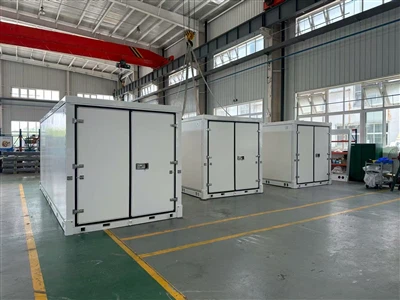
In FRP sandwich panel systems used in truck bodies, modular buildings, refrigerated enclosures, and industrial equipment housings, the core layer defines shear transfer behavior, panel thickness stability, and mass distribution across the panel cross-section. FRP skins alone cannot maintain structural spacing under bending load; the core material provides the internal geometry that supports load transfer between skins.
Different core materials such as PP honeycomb, PET foam, PU foam, balsa wood, and aluminum honeycomb are selected based on density range, moisture exposure, compressive load, and production process compatibility. In industrial lamination lines, core selection is completed before FRP skin bonding to match adhesive system viscosity, curing temperature, and pressing pressure conditions..

What the Core Layer Does Inside a Sandwich Panel Structure
The core layer in an FRP sandwich panel does not primarily carry tensile or compressive loads. Instead, it performs three mechanical functions:
During panel bending, the upper FRP skin experiences compressive stress while the lower skin experiences tensile stress. The core material distributes shear forces across its internal structure, preventing localized deformation.
In production, adhesive is applied between FRP skins and core surfaces using roller coating or spray systems, followed by vacuum pressing at controlled pressure to ensure full contact across the core interface.
PP Honeycomb Core: Geometry for Shear Transfer
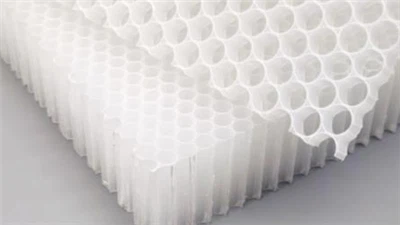
Manufactured by extruding polypropylene sheets and expanding them into a hexagonal cell structure through thermal forming. Typical industrial specifications include:
Each hexagonal cell wall functions as a shear transfer path that distributes load across the panel thickness. Unlike solid polymer sheets, PP honeycomb reduces continuous material volume while maintaining structural separation between FRP skins. HolyCore provides dimensionally controlled CNC nesting layouts to drastically reduce trimming loss.
PET Foam Core: Closed-Cell Moisture Control
Produced from recycled polyethylene terephthalate through foaming and cooling processes that create a closed-cell structure. Density typically ranges from 60–200 kg/m³ depending on compression resistance requirements.
The closed-cell structure limits water absorption by blocking capillary pathways, allowing the material to resist moisture penetration during condensation cycles in refrigerated transport systems. PET foam transfers compressive loads through uniform cell deformation rather than discrete structural nodes. Lamination is followed by flat pressing under 70°C to avoid cell collapse.
PU Foam Core
Rigid polyurethane foam is formed by chemical reactions between polyols and isocyanates (density 30–80 kg/m³). It primarily resists thermal transfer while supporting moderate loads in cold-chain spaces (-18°C to +5°C). Under long-term static mechanical loading, it can exhibit creep deformation.
Balsa Wood Core
Produced from natural wood with longitudinal fiber orientation (density 100–200 kg/m³). It provides anisotropic mechanical properties and high compression resistance along the grain. Requires strict edge sealing; otherwise, water ingress can travel along channels, leading to swelling and loss of shear transfer capacity.
Aluminum Honeycomb
Formed by expanding bonded aluminum foil sheets into hexagonal cells (density 20–80 kg/m³). The metallic structure provides high stiffness-to-weight efficiency but can develop corrosion in humid or salt-exposed environments if surface treatment is omitted. Requires precise epoxy bonding.
Engineering Selection Matrix
Associated Failure Mechanisms
- PP Honeycomb: Wall shear failure or localized edge crushing
- PET Foam: Compression deformation under localized heavy impacts
- PU Foam: Long-term mechanical creep deformation metrics
- Balsa Wood: Moisture-induced fiber swelling and layer delamination
- Aluminum Honeycomb: Core fatigue cracking or joint corrosion
How Core Materials Integrate into Production
HolyCore Engineering Role in Core Supply Systems
HolyCore focuses on advanced PP honeycomb core systems optimized explicitly for integrated sandwich panel production. Professional support structures include:
In transportation and industrial enclosure fields, selecting core geometries before lamination minimizes post-processing trimming errors and ensures an unmatched structural module assembly fit.